
- Chennai
- Tamil Nadu
- India
- World
- EntertainmentEntertainment
- Business
- Sports
- Lifestyle
- Technology
- Videos
- Explainers
- Editor's Picks
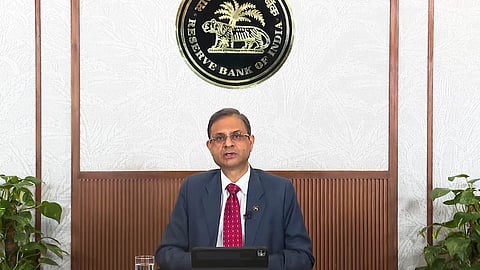
MUMBAI: The Reserve Bank of India (RBI) Governor Sanjay Malhotra on Friday said its 4 per cent medium-term inflation target is sacrosanct and has not been put in abeyance.
Malhotra, who upped the central bank's FY27 consumer inflation estimate by 0.5 per cent to 5.1 per cent, indicated that any future monetary policy action would depend on whether price rise becomes broad-based and persistent.
Malhotra rejected suggestions that the central bank may be prioritising growth over inflation and shifting focus to the wider 2-6 per cent tolerance band, saying the inflation target remains unchanged.
"The target is not in abeyance at all. It's a target which the government has given to us. It remains 4 per cent, and that is what our endeavour is," Malhotra said during the post-monetary policy press conference.
He, however, clarified that the inflation target is to be achieved over a medium-term horizon, and not through responses to every short-term deviation, as aggressive action against temporary shocks could have disproportionate consequences for growth.
Without signalling any imminent tightening, the governor acknowledged that inflation conditions had turned more adverse than earlier.
Replying to a specific query on the upping of inflation estimate and whether it should be deduced as a rate hike is imminent at the next review, Malhotra said, "Whether it strengthens the case or not, I don't know, but obviously it's more adverse than it was previously".
On Friday, the central bank kept the repo rate unchanged at 5.25 per cent and decided to continue with a 'neutral' stance.
Malhotra said the central bank would closely watch whether inflationary pressures remain temporary or become generalised and persistent.
"If it is a one-time increase, then you look through. But if it is getting generalised, it is getting persistent, it is getting into expectations, then it is the time to act," he pointed out.
He reiterated that the RBI would remain data-dependent and closely monitor whether supply-led inflation shocks fade or become entrenched.
He reiterated that the RBI would remain data-dependent and closely monitor whether supply-led inflation shocks fade or become entrenched.
In the monetary policy, the RBI revised the consumer price index (CPI) inflation upward by 0.50 per cent for the FY27 due to the West Asia crisis, which will exert pressure on inflation in the coming months as firms pass on higher input costs.
The partial pass-through of high global crude oil prices to domestic pump prices of petrol and diesel started in May. Prices of several inputs such as commercial LPG, industrial raw materials, chemicals, base metals, rubber, and plastic products, among others, have increased. These could exert upward pressure on CPI inflation in the coming months as firms pass on higher input costs, the RBI said.
The central bank projected CPI inflation for Q1 FY27 at 4.2 per cent, Q2 FY27 at 5.1 per cent, Q3 FY27 at 5.9 per cent, and Q4 FY27 at 5.4 per cent. Core inflation is projected at 4.7 per cent for FY27.
"These forecasts are subject to upside risks due to global supply chain disruptions, global commodity price shocks, uncertainty about the spatial and temporal distribution of the south-west monsoon and El Nino conditions," the RBI governor said.
Longevity of supply chain pressures triggered by the West Asia war and their impact on the prices is the foremost focus area for the RBI at the current juncture, the governor said, adding that the monsoon-related challenges come next.
He said the central bank has revised its oil price estimate to USD 95 per barrel for FY27 from the earlier USD 85 per barrel, and attributed it as one of the prime reasons for the increased CPI estimate.