
- Chennai
- Tamil Nadu
- India
- World
- EntertainmentEntertainment
- Business
- Sports
- Lifestyle
- Technology
- Videos
- Explainers
- Editor's Picks

NEW DELHI: Commerce and Industry Minister Piyush Goyal on Monday said the free trade agreement with New Zealand is the seventh such pact signed under his tenure in the past three-and-a-half years and two more agreements with the European Union and the US are expected in the coming months
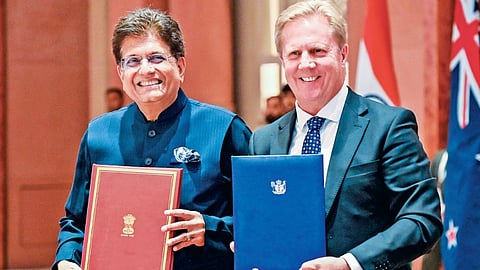
Goyal and visiting New Zealand’s Trade and Investment Minister Todd McClay here inked a free trade agreement, which is expected to come into force by the end of this year.
“With this (India-New Zealand) FTA, it is the seventh free trade agreement that I am signing in the last three and a half years. Two more to go very soon in the next few months with the European Union (EU) and the United States of America (USA),” he told reporters here.
India and the 27-nation bloc EU in January announced the closure of negotiations for a trade pact. It has not been signed yet.
The NDA government has so far finalised FTAs with the UAE (implemented in May 2022), Australia (implemented in December 2022), the UK (signed in July 2025), EFTA bloc (implemented in October 2025), Oman (signed in December 2025), European Union (announced closure of negotiations in January 2026), and Mauritius (came into force from April 2021).
The remarks are important as an Indian official team returned from Washington last week after holding three-day talks with US authorities on finalising the first phase of the bilateral trade agreement.
Both sides discussed several areas, such as market access, non-tariff measures, technical barriers to trade, customs and trade facilitation, investment promotion, economic security alignment and digital trade.
India and the US issued a joint statement on February 7 finalising a framework for an interim trade agreement regarding reciprocal and mutually beneficial trade.
The framework requires recalibration in view of changes in the US tariff landscape.
India has not offered any duty concessions in the dairy sector under any of its FTAs so far, including those with the European Union, the UK, New Zealand, and Australia, Goyal said on Monday.
He said India’s dairy sector is driven by very small and marginal farmers with limited landholdings who own only a few cattle.
These farmers has a “very” low production and needs to be protected against large farms that Europe, America, Australia, or New Zealand have. “India has had a very consistent stand in all our FTAs across the world, whether it is European Union, Switzerland... UK, USA, Australia, New Zealand. Never has India opened the dairy sector. Everybody in this room knows it. Everybody in the world knows it,” he told reporters here.
This is a known position, and there is nothing new in this, he said. However, he added as per India’s foreign trade policy, the government allows foreign firms to bring raw materials or ingredients into India, process them to make high-quality products and then re-export 100 per cent of those goods. That product is not allowed to be sold in the country, he said.