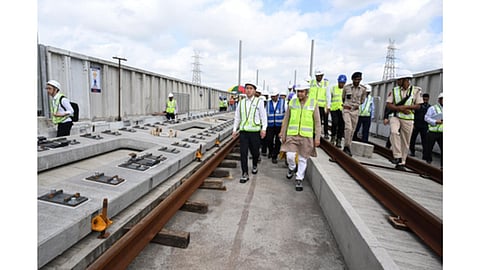

NEW DELHI: The government on Wednesday said India’s tunnel infrastructure reflects a clear shift toward smarter and more resilient development, solving long-standing connectivity challenges while supporting economic growth and national priorities.
With landmark projects like the Atal Tunnel, India is rapidly expanding its tunnel infrastructure. Tunnels in India represent more than infrastructure development; they reflect the nation’s determination to overcome geographical challenges.
By cutting through mountains and terrain that once limited connectivity, tunnels have enabled year-round transportation. They have also improved access to remote regions and strengthened links between communities, according to an official statement.
India’s tunnelling boom is being propelled by national highway expansion, alongside strategic border infrastructure, metro rail growth, bullet-train corridors, and all-weather connectivity initiatives in remote regions.
As infrastructure scales up, tunnelling has become one of the fastest-growing construction domains.
Tucked beneath the snow-laden peaks of the Pir Panjal ranges, the Atal Tunnel stretches 9.02 km, providing a high-altitude passage that bypasses Rohtang Pass.
“It is officially recognised as the World’s Longest Highway Tunnel above 10,000 feet in 2022 by the World Book of Records UK. The tunnel has cut the Manali–Sarchu distance by 46 km and reduced travel time by four to five hours,” the statement added.
Another example is the Sonamarg Tunnel, a 12-km engineering feat carved through mountains at an altitude of over 8,650 feet above sea level, is set to transform travel in Jammu and Kashmir.
Built at a cost of Rs 2,700 crore, it includes a 6.4-km main tunnel, an egress tunnel, and modern approach roads creating an all-weather lifeline between Srinagar and the golden meadows of Sonamarg, and further towards Ladakh.
Once paired with the upcoming Zojila Tunnel (2028), the journey will shrink from 49 km to 43 km, with speeds rising from 30 km per hour to 70 km per hour, boosting defense logistics, winter tourism, adventure sports, and the livelihoods of the people who call these mountains home.
Moreover, the Zojila Tunnel is emerging as a monumental achievement in India’s infrastructure landscape, cutting through some of the most formidable Himalayan rock formations to establish a dependable, all-weather link between Ladakh and the rest of the country.
With nearly 12 kms already completed, the project integrates advanced safety measures and a semi-transverse ventilation system designed to maintain steady airflow deep within the mountains, said the government.
India’s Mumbai–Ahmedabad High-Speed Rail corridor has marked a futuristic leap with the breakthrough on its 4.8-km undersea tunnel section.