
- Chennai
- Tamil Nadu
- India
- World
- EntertainmentEntertainment
- Business
- Sports
- Lifestyle
- Technology
- Videos
- Explainers
- Editor's Picks
NEW DELHI: Commerce and Industry Minister Piyush Goyal said on Monday that the India and New Zealand free trade agreement (FTA) will ensure zero duty on 100 per cent of India’s exports, benefitting farmers, MSMEs, workers, artisans, women-led enterprises and youth, while providing immense opportunities for labour-intensive sectors such as textiles, apparel, leather and footwear.
Sectors like engineering and manufacturing, automobiles, electronics, machinery, plastics, pharmaceuticals and chemicals will also stand to benefit.
He said that agreement also provides a significant boost to investments, with New Zealand committing to facilitating $20 billion in FDI into India over 15 years, targeting manufacturing, infrastructure, services, innovation and job creation.
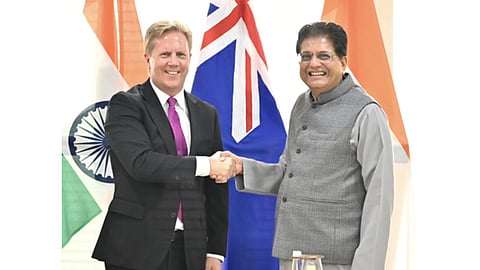
“Under the guidance and leadership of Prime Minister Narendra Modi, New Zealand PM Christopher Luxon, and with the close and collaborative engagement of my friend and counterpart Minister Todd McClay, India and New Zealand have successfully concluded a landmark Free Trade Agreement in a record nine months. This marks a significant milestone in our bilateral ties,” Goyal said in a post on X.
The minister further stated that with a focus on empowering farmers, the FTA opens new opportunities for Indian agricultural products in New Zealand’s markets, including fruits, vegetables, coffee, spices, cereals, and processed foods.
Through the Agricultural Productivity Partnership, Centres of Excellence, and access to New Zealand’s advanced agri-technologies, farmers will significantly benefit from higher productivity, improved quality, and higher incomes. Targeted initiatives for horticultural products such as honey, kiwifruit and apples further strengthen the sector and support sustainable growth.
In view of domestic sensitivities, India has safeguarded agriculture and allied products, including dairy, sugar, coffee, spices, edible oils, precious metals (gold and silver), precious-metal scrap, copper cathodes, and rubber-based products, thereby ensuring the protection of farmers, MSMEs, and domestic industries, the minister explained.
The FTA creates new opportunities for India’s services sector, spanning IT and ITeS, finance, education, tourism, construction, and other areas. New Zealand’s first-ever annexes on health, traditional medicine, student mobility, and post-study work open up unprecedented avenues for Indian professionals and students. In addition, enhanced mobility provisions, including working holiday visas, post-study work pathways, and a dedicated quota of 5,000 temporary employment visas for skilled Indian professionals, will enable Indian talent to access better global opportunities, Goyal further stated.
“This mutually beneficial Agreement will further strengthen the India-New Zealand economic partnership and advance India’s journey towards the vision of Viksit Bharat 2047,” Goyal added.
The agreement also includes the best-ever market access and services offer by New Zealand to India, covering 118 services sectors including computer Related Services, Professional Services, Audio Visual Services, Telecommunication Services, Construction Services, Tourism and Travel related Service. Most-Favoured Nation Commitment in about 139 sub-sectors, according to a Commerce Ministry statement.
The FTA opens skilled employment pathways through a new Temporary Employment Entry Visa pathway for Indian professionals in skilled occupations, with a quota of 5,000 visas at any given time and a stay of up to three years. This pathway covers Indian professions such as Ayush practitioners, yoga instructors, Indian chefs, and music teachers, as well as high-demand sectors including IT, engineering, healthcare, education, and construction, strengthening workforce mobility and services trade
Apart from tariff liberalisation, the FTA includes provisions to address non-tariff barriers through enhanced regulatory cooperation, transparency, and streamlined customs, Sanitary and Phyto-sanitary (SPS) measures and Technical Barriers to Trade disciplines. All systemic facilitations and fast-track mechanisms for imports that serve as inputs for our manufactured exports ensure that tariff concessions translate into effective and meaningful market access, the statement added.
Commenting on the FTA, New Zealand Prime Minister Luxon said, “We’ve concluded a Free Trade Agreement with India. This will open doors for New Zealand farmers, growers, and businesses - boosting exports, creating jobs, and lifting incomes to help all Kiwis get ahead.”
