
- Chennai
- Tamil Nadu
- India
- World
- EntertainmentEntertainment
- Business
- Sports
- Lifestyle
- Technology
- Videos
- Explainers
- Editor's Picks

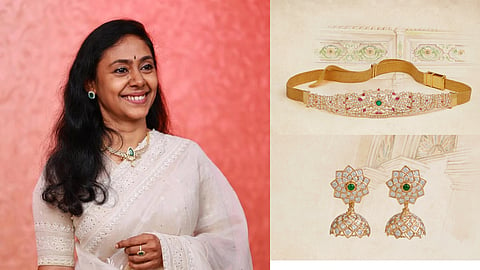
CHENNAI: “The younger generation is wearing nethi chutti, jada billa, chandran-suryan again,” exclaims luxury jewellery designer Meenu Subbiah.
“These pieces were once considered outdated. Today they are coming back with pride.” That revival, she believes, reflects a larger shift underway in India’s jewellery landscape, one where heritage, individuality and craftsmanship are finding renewed relevance among younger buyers, including men.
“We are now seeing growing demand for men’s jewellery too... chokers, malas and statement neckpieces,” she says.
“What celebrities wear quickly becomes a trend.” Men’s jewellery today contributes nearly 15 to 20 per cent of the brand’s business, a category she sees steadily expanding as jewellery moves beyond convention into self-expression.
For Meenu, jewellery goes beyond ornamental purpose. “It’s an experience, a legacy, a story that lives across generations,” she tells DT Next.
Over the last 33 years, she has quietly built a niche design-led jewellery brand Meenu Subbiah Diamonds rooted in Chettinad aesthetics while reinterpreting tradition for contemporary wearers. It has spread beyond Chennai to Coimbatore, Karaikudi, and the US.
At a time when many families were dismantling heirloom jewellery to create modern pieces, Meenu consciously resisted the trend. “When clients came wanting to redesign old jewellery, I never encouraged destroying the original piece,” she says.
“I would restyle it or add elements to make it wearable again. Once you remake it completely, the history is lost forever.” This philosophy saw the birth of her three brands: Vilasam, Vamsam and Menaya, each catering to distinct sensibilities while remaining connected to heritage and craftsmanship.
Born into the culturally-rich Chettinad community, Meenu grew up seeing jewellery integrated into every life stage, where every ornament carried meaning, functionality and symbolism. “People think Chettinad jewellery is heavy,” she says. “But authentic Chettinad jewellery is actually fluid and flexible. It moves with you. Every piece is handcrafted to fall naturally on the body.”
Her fascination with jewellery led her to formally study jewellery design in the US in the early 1990s, a rare move at a time when jewellery design was neither a structured profession nor a common career path for women.“When I returned, the industry was almost entirely male-dominated,” recalls one of south’s first few graduate diamonds from GIA-USA. “There were hardly any women formally trained in jewellery design.”
She began from her room in Chennai with just four artisans, initially focusing on exclusive diamond jewellery. Today, it employs around 60 people, including nearly 35 artisans, many of them fourth and fifth-generation craftsmen.
But preserving those skills remains a key concern.“This kind of craftsmanship cannot be trained overnight,” she says. “The precision, speed and aesthetic understanding come from generations of inherited practice. If younger artisans move away from this, the craft itself will slowly disappear.” That concern eventually led to the creation of Pettagam, India’s first private museum dedicated to Chettinad jewellery in Karaikudi. Built like a traditional Chettinad home, the museum documents regional motifs, techniques and jewellery traditions that Meenu believes have remained largely absent from mainstream Indian jewellery narratives.
“There’s so much richness in south Indian jewellery, especially from the Chola and Pandya periods, but globally, the narrative is dominated by north Indian jewellery, particularly Jaipur. I realised that this southern legacy needed to be brought forward. Coming from Chettinad, I grew up seeing a deeply embedded jewellery culture. From birth, every occasion had a specific type of jewellery, each designed with purpose. For example, jewellery for children called pulla nagai was designed without sharp edges, with soft, twisted forms that wouldn’t hurt them, even if they put it in their mouth. Everything had thought, function, and design behind it.”
Her revival effort has also translated into strong business momentum. As per Ganeshan Suppiah, partner, Meenu Subbiah Diamonds, the company has been growing consistently at nearly 18 to 20 per cent year-on-year and is now targeting around 25 per cent annual growth after sharpening the identity of its three brands.
Yet scale, they insist, will not come at the cost of design integrity.“We don’t want to become another mass jewellery brand,” says Ganeshan. “We want to build globally recognised design-led luxury brands from India.”
The strongest demand is increasingly coming from international markets such as the US and Singapore, where customers actively seek culturally rooted jewellery. “International buyers returned to traditional jewellery faster than domestic audiences,” says Meenu. “They are deeply connected to preserving their roots.”