
- Chennai
- Tamil Nadu
- India
- World
- EntertainmentEntertainment
- Business
- Sports
- Lifestyle
- Technology
- Videos
- Explainers
- Editor's Picks

CHENNAI: Betting big on India’s fast-rising demand for vertical mobility, Johnson Lifts is stepping up its push into home elevators and public infrastructure even as it leverages its early-mover advantage as one of the country’s pioneers in escalator manufacturing.
The Chennai-based company, which began as a manual lifts player in Vyasarpadi, has evolved into a national leader commanding about 20 per cent share of India’s roughly 1.5-lakh-unit annual elevator market.
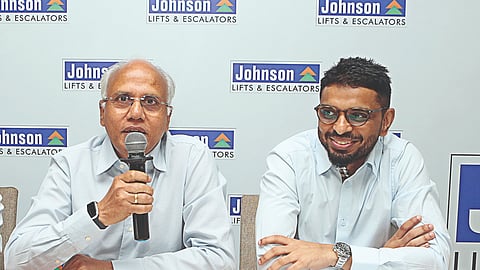
Its latest move, the launch of ‘Eazy Ride Plus,’ a bespoke compact home lift six months ago, has already seen about 20 units sold in Chennai, where the product is being piloted. “Home lifts are a natural next step as individual homes start demanding vertical mobility,” said Yohan K John, third-generation executive at Johnson Lifts.
Priced at about Rs 22 to 23 lakh, the product is designed for quick installation within a week and targets independent homes and lowrise residential buildings. The timing is significant as residential projects account for 75 to 80 per cent of demand, with tier-2 and tier-3 cities emerging as key growth engines.
V Jagannathan, MD-CEO, Johnson Lifts, underlined the firm’s domestic leadership. “India is the only major market where a homegrown company leads the elevator segment. We have held that position for over a decade,” he told
Johnson is also doubling down on infrastructure, drawing on its early bet on local escalator manufacturing, a move that initially drew scepticism. “When we started manufacturing escalators in India, many felt there was no market. We wanted technological independence, and today the infrastructure boom is validating that decision,” Jagannathan said.
The company has strengthened its credentials with marquee assignments, including 28 lifts installed at the Seva Teerth PMO complex through an L&T contract in under a year. It is also seeing traction from Delhi Metro Phase V and the broader railway modernisation pipeline.
Johnson now views metros, railway redevelopment, where it is involved in about 40 projects nationwide, and airports as the largest growth engines for its escalator business. “Public infrastructure, especially metros, will continue to drive escalator demand,” Yohan, director, Johnson Lifts, said.
Producing about 18,000 lifts annually, Johnson employs 10,000 to 11,000 people. The south contributes nearly 48 per cent of revenue, though the company is stepping up its presence in western and northern markets. Revenue is expected to surge from about Rs 3,000 crore last year to Rs 3,500 crore this year, with management targeting the Rs 5,000-crore mark by 2030.
To prepare for the next phase, the company is investing over Rs 150 crore to expand its Sengadu facility near Chennai, including a 150-metre testing tower for highspeed elevators. “We are preparing for the high-speed lift era in India,” Yohan said, citing rising high-rise construction in Mumbai, Bengaluru and Hyderabad. Johnson has fully transitioned to gearless, energy-efficient elevators, while IoT-enabled solutions are in the pipeline, though network reliability remains a challenge.
New equipment sales contribute about Rs 2,500 crore, while maintenance and modernisation generate Rs 500 to Rs 600 crore and are expected to grow 30 to 40 per cent annually. “The installation is only the beginning... service is a 15 to 20-year commitment,” Jagannathan noted.
Despite a presence in the Middle East, South Asia and Africa, it remains focused on the domestic opportunity. However, management flagged manpower shortages as the single biggest constraint as demand accelerates across housing and infrastructure.
With the tier2/3 housing boom, railway redevelopment wave and high-speed elevator opportunity gathering pace, Johnson Lifts is positioning itself for its next growth cycle in India.