
- Chennai
- Tamil Nadu
- India
- World
- EntertainmentEntertainment
- Business
- Sports
- Lifestyle
- Technology
- Videos
- Explainers
- Editor's Picks
HONG KONG: Asian shares were mostly higher on Tuesday, tracking Wall Street gains, while the Japanese yen was trading near a 40-year low against the US dollar.
Shares in South Korea, Japan and Taiwan rebounded from earlier losses spurred by selling of technology companies due to concerns over the sustainability of the boom in artificial intelligence.
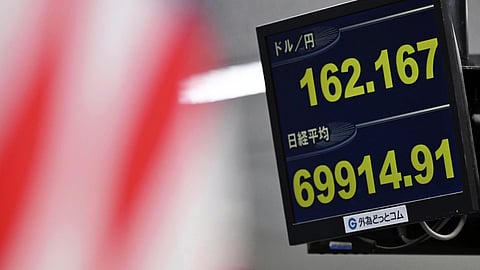
Tokyo's Nikkei 225 was up 0.9% to 70,062.32. Chip equipment maker Tokyo Electron jumped 3.3%. SoftBank Group, an investment holding company that invests in OpenAI, was up 1.2%.
South Korea's Kospi index, which has performed strongly during the global AI frenzy due to growing demand for memory chips from major chipmakers like SK Hynix, gained 1 to 8,476.48.
Shares of Samsung Electronics rose 3.4% and those of SK Hynix rose 0.8% after the two companies and the government jointly announced plans for over $500 billion of investments in the country's chipmaking and AI.
Elsewhere in Asia, Hong Kong's Hang Seng shed 0.6% to 22,879.87 and the Shanghai Composite index rose 0.5% to 4,094.40. Taiwan's Taiex picked up 2.5%.
China reported its factory activity slightly picked up pace in June, mainly due to exports and demand generated by expanding use of AI. The survey released by the National Bureau of Statistics said the manufacturing purchasing managers index, or PMI, expanded to 50.3 in June from 50 in May. That's better than had been expected.
Australia's S&P/ASX 200 dropped 0.5% to 8,778.70, while India's Sensex was nearly unchanged.
The dollar rose to nearly 162.42 yen early Tuesday in Tokyo, its highest level since late 1986, and was trading at 162.16 yen by late afternoon.
The yen's prolonged slump against the dollar, largely due to a gap between interest rates in the US and Japan, has spurred speculation that Tokyo might intervene to prop up the currency. However, Japan's finance minister said only that the government was ready to “respond appropriately whenever necessary.”
The dollar to yen rate “has spiked above 162 as everyone is holding their breath to see when Japanese officials intervene,” Ipek Ozkardeskaya of Swissquote said in a commentary. “Intervening now would change nothing about the underlying market direction, but would cost dearly. Unless we see an aggressive sell-off in the yen, the Japanese authorities seem willing to remain on the sidelines.”
The euro fell to $1.1409 from $1.1422.
US futures edged higher.
On Monday, Wall Street's benchmark S&P 500 added 1.2%. The Dow Jones Industrial Average climbed 0.6%, and the Nasdaq composite gained 2.1%.
Intel gained 2.7%, Micron Technology climbed 1.1%, Nvidia rose 1.3% and AMD, or Advanced Micro Devices, was 3.4% higher.
Oil prices fell modestly early Tuesday as traders monitored developments in negotiations between the US and Iran on ending their four-month war.
Crude prices have stabilized following attacks across the Persian Gulf over the weekend after the United States and Iran separately announced they will send delegations to Qatar this week, though Tehran insisted it has not agreed to meet with the United States “at any level.”
Brent crude, the international standard, fell 0.7% to $73.40 a barrel. It was trading near $72 per barrel before the war began to disrupt transport of oil and gas through the Strait of Hormuz.
Benchmark US crude declined 0.8% to $70.22 a barrel.
The hope is that an end to the war with Iran will restore full access to the strait, allowing tankers to exit the Persian Gulf and deliver crude to customers worldwide. That would help lower the price of oil, whose jumps because of the war have sent a punishing wave of inflation around the world.
