
- Chennai
- Tamil Nadu
- India
- World
- EntertainmentEntertainment
- Business
- Sports
- Lifestyle
- Technology
- Videos
- Explainers
- Editor's Picks

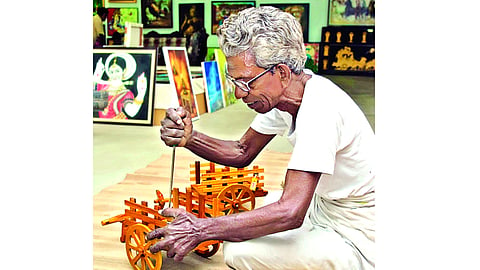
CHENNAI: India's vast handicraft and handloom economy, often showcased as a symbol of heritage and sustainable production, continues to run on low incomes, unpaid family labour and fragile livelihoods despite employing lakhs of workers and contributing significantly to manufacturing activity, according to a major study conducted across five states, including Tamil Nadu.
The study, "Economics of Indian Craft: Estimating Employment and Value Added in the Handicraft and Handloom Sector", estimates that nearly 61.1 lakh workers are engaged in around 34 lakh handloom and handicraft establishments across Tamil Nadu, Uttar Pradesh, Rajasthan, Assam and West Bengal.
The study was jointly conducted by the Institute for Human Development (IHD) and the Chennai-based Crafts Council of India (CCI) and formally released on May 18 at the India International Centre.
The survey examined over 4,600 handloom and handicraft establishments across rural and urban areas. The sector accounts for 26 per cent of the total workforce in manufacturing establishments in these states, while 42 per cent of manufacturing establishments are linked to handloom and handicraft activity.
Despite this scale, workers' earnings remain critically low. Researchers found that the average artisan earns around Rs 270 a day, or nearly Rs 7,000 a month. This is well below the prescribed minimum wage for skilled workers, even in the agricultural sector. The study says a majority of units survive through family-based labour, with most establishments employing only one or two workers from the same household.
Over half of the surveyed establishments are in rural areas, reinforcing crafts and weaving as one of the largest non-farm livelihood sources in India. Tamil Nadu emerged as one of the important centres of both handloom and handicraft activity, with clusters spread across Salem, Coimbatore, Thanjavur and Karur, among others.
The report notes that the state continues to retain a strong traditional production base even as artisans face financial and market pressures. The findings also point out a widening disconnect between the growing visibility of handmade products and the economic condition of artisans producing them.
It says most workers remain dependent on contractors, master weavers and intermediaries for raw materials, production orders and market access. Artisans have limited control over pricing, product design or direct sales, leaving them vulnerable to fluctuations in demand and raw material costs. One of the major findings is the low penetration of institutional support.
Researchers found minimal awareness and use of government schemes, formal credit systems and welfare support across surveyed states. Registration levels, including under GST frameworks, were found to be poor. Only a small number of establishments maintained formal accounts.
The study also challenges several long-standing assumptions about the sector.
Contrary to the perception that the work is seasonal, artisan establishments reported they functioned around the year, except in certain geographies like Assam. Researchers also found that exhibitions and fairs, often promoted as major income avenues for artisans, contributed very little to actual earnings or market expansion.
Use of e-commerce platforms was found to be negligible, while contact with export agencies, khadi institutions and organised private buyers remained extremely limited. The report notes that despite demand for handmade products increasing in urban and overseas markets, the benefits are not adequately reaching producers at the grassroots level.
The survey recorded strong participation of women in the sector, particularly in ownership of proprietary establishments. Researchers say the sector provides earning opportunities for women while allowing them to combine income generation with domestic responsibilities.
However, the report also raises questions over whether ownership necessarily translates into decision-making control or financial independence. It highlights several structural barriers affecting artisanal communities, including low education levels, limited exposure to technology, weak entrepreneurial capacity and high debt.
Occupational health risks and the absence of social security were identified as major concerns affecting the long-term sustainability of the sector.
Researchers also documented how the handmade economy acted as a buffer during crisis periods like the COVID-19 lockdown, demonetisation and sudden market disruptions. In several regions, craft activity emerged as fallback employment for households affected by migration and loss of urban jobs.
The study estimates that annual Gross Value Added generated by handloom and handicraft establishments in the five states amounts to 1.31 per cent of total manufacturing GVA and around 0.17 per cent of national GDP in 2023-24. Yet the report argues that the actual scale of India's handmade economy could be much larger, since many traditional occupations remain outside official definitions of "artisan" and "handicraft".
The report calls for stronger policy support, focused on easier access to finance and raw materials, entrepreneurship training, social security, occupational health protection and better integration of handmade industries into formal economic planning.
For Tamil Nadu, where handloom and handicraft production continues to support thousands of families across traditional weaving and craft belts, the findings underline the growing economic stress behind one of India's most visible cultural industries.
The study ultimately adds that while India's handmade sector remains a major source of employment and manufacturing activity, artisans continue to remain economically vulnerable, poorly protected and largely excluded from the gains of expanding markets.