
- Chennai
- Tamil Nadu
- India
- World
- EntertainmentEntertainment
- Business
- Sports
- Lifestyle
- Technology
- Videos
- Explainers
- Editor's Picks

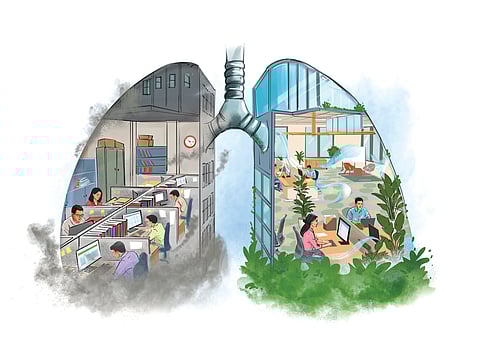
CHENNAI: Ever caught yourself stifling a yawn in the middle of a meeting? If you were blaming the haze on a stuffy conference room or a heavy lunch, you may be mistaken. According to a 2016 study from Harvard University, the real culprit behind the exhaustion could very well be the air circulating throughout office buildings, which has the potential to dull the minds of the people who work inside them.
As per the study, which was conducted in a controlled environment, researchers found that the cognitive scores of workers were a staggering 101% higher when they were breathing cleaner air compared to a stuffy and crowded office environment.
It may be noted that the findings, published in the Environmental
Health Perspectives’, were excellent indicators that it was time to tweak the design of workspaces in our country to ensure efficient output.
In the 1970s, when energy prices were skyrocketing, buildings became smaller and stuffier, which led to a significant drop in air quality. The ventilation requirements for commercial buildings were lowered in the following decade to save energy, which resulted in the ‘Sick Building Syndrome’, where headaches, fatigue and brain fog were found to be the main problems faced by employees working in these structures while gasping for clean air.
While taking cognisance of the issue in the following years, many green building rating systems were designed with sustainable conditions such as low-emitting materials, better filtration and more outdoor air. However, even at present, many buildings continue to meet only the minimum standards.
As part of the study, researchers from New York made 24 employees from various sectors like architecture, software programming, engineering and marketing spend six full working days inside an environmentally controlled office lab.
However, in an effort to prevent bias, they followed the double-blind experiment method, where neither the participants nor the analysts evaluating their performance were aware of the kind of air they were breathing each day.
While some days were similar to a more conventional office setup, where toxins or volatile organic compounds (VOCs) from items that people use on an everyday basis, like particle board, adhesives, cleaning products and markers used on dry boards, were incorporated more, there were other days which simulated a ‘green’ office with low chemical levels and standard ventilation. Apart from this, there were also days when they incorporated a third condition called ‘green+’, in which they ensured that the employees were subjected to double the amount of fresh outdoor air.
To evaluate progress everyday, participants were made to take a 1.5hour computerised test called the ‘Strategic Management Simulation’. The test measured cognitive function at the highest level across various spectrums, such as crisis response, strategic planning, information usage and task orientation, which required the professionals to bring in their maximum performance levels.
In a shocking revelation, the results showed that across all the main cognitive domains, average scores were 61% higher under ‘green’ conditions than under a conventional office setup, while under ‘green+’ conditions, the scores categorically doubled to 101%. The responses were as follows:
Crisis response – The ability to think and act under pressure was 97% higher in ‘green’ and 131% higher in ‘green+’ compared to the conventional office
Usage of information – The ability to use the gathered information toward goals was 172% higher in ‘green’ and 299% higher in ‘green+’
Strategy – The ability to think in a complex manner, plan, and prioritise saw a jump to 183% in ‘green’ and 288% higher in ‘green+’
With these numbers, it was revealed that poor air quality does not just make people uncomfortable and dull, but also makes them less capable in the workplace.
For several years, building engineers have gone under the assumption that if the carbon dioxide (CO2) levels were acceptable, then the rest of the air quality was fine and the place was sufficiently ventilated. However, the recent study has challenged this notion and revealed that if an office merely meets the minimum building codes for ventilation, it could cost employees one-fifth of their effective thinking capacity.
According to the study, when researchers maintained every other factor at a constant level but just increased the CO2 levels inside the workspace, they were startled to notice that the cognitive scores began to drop. When CO2 levels were raised by 400 parts per million (ppm), they noticed a 21% dip in cognition across all domains.
It may come as a shock to note that in a regular office setup, the volatile organic compounds (VOCs) were not industrial-grade toxins. Rather, they were everyday items used in offices, such as particle board, duct tape, packing tape, multi-surface cleaner, dry-erase markers and correction fluid.
Some of the chemical substances, such as formaldehyde, acetaldehyde and heptane, found in these office stationery items, spiked the total VOC levels by 500 mcg per cubic metre, resulting in a 13% dip in cognition, regardless of the levels of carbon dioxide and ventilation.
According to statistics, Indians spend nearly three-fourths of their time indoors, in places such as offices, homes, schools and cars.
While many of these structures are certified as ‘green buildings’, many others, which were built several years ago, still operate at minimum ventilation standards.
If one goes by the Harvard study, it can be inferred that by merely doubling ventilation from 20-40 cubic feet per minute per person, workplaces can see a remarkable 18% additional cognitive boost, leading to better productivity.
While change cannot be brought overnight in countries like India, where corporate real estate is expanding rapidly, small steps such as better ventilation and low carbon-emitting materials may no longer be important only for environmental sustainability, but also for improving the performance of the workforce.
In a regular office setup, the volatile organic compounds (VOCs) were not industrial-grade toxins. Rather, they were everyday items used in offices, such as particle board, duct tape, packing tape, multi-surface cleaner, dry-erase markers and correction fluid