
- Chennai
- Tamil Nadu
- India
- World
- EntertainmentEntertainment
- Business
- Sports
- Lifestyle
- Technology
- Videos
- Explainers
- Editor's Picks

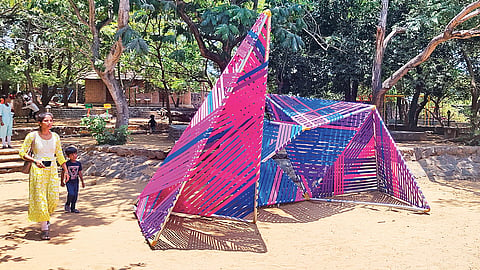
At DakshinaChitra, the newly launched on-site installation Ammam - A Space for Peace begins with something deceptively simple: a word. Ammam carries echoes across cultures, sounding close to Amma in Tamil and Mamma in Italian.
Somewhere between those sounds lies the emotional centre of the work, created by Chennai-based architect and artist Renuka Devi and Italian architect and artist Alessio Patalocco.
Built from iron piping interwoven with strips of pink, blue, and violet, the structure invites visitors to write directly onto the woven strips, leaving behind memories, reflections, and fragments of personal experience. The colours of the installation are traditionally associated with femininity, refusing rigid definitions while suggesting tenderness, openness and emotional complexity. Over time, the installation transforms into a collective archive, shaped as much by strangers as by the artists themselves.
For Renuka and Alessio, the collaboration evolved organically through teaching at the VIT School of Architecture, where they met in June 2025. Their discussions returned to a deeply emotional instinct: the unquestioned urge to turn toward one’s mother. That emotional reflex became the conceptual heart of Ammam.
Renuka describes the installation as ‘a secular sanctuary defined not by religion, but by shared human experience.’ For her, presenting the installation at DakshinaChitra carries personal resonance. “I visited the museum in 2007 as an architecture student and it was one of my earliest encounters with living heritage.
What’s inspiring is the way traditional built environments there did not feel frozen in time, but inhabited and emotionally accessible. In many ways, Ammam extends that same spirit. The installation only becomes complete when visitors interact with it, write on it and leave pieces of themselves behind. In many ways, it feels like the work has come home,” she says.
Alessio sees universality emerging precisely through personal experience. According to him, private emotions often reveal the strongest common ground between people.
“Even in a language unintelligible to you, if you look deeper into the eyes of the person you are speaking to, you can find the same fears, emotions or thinking that you also have,” he reflects. That idea of emotional recognition across language barriers became central to the project, including its title. “During conversations with Renuka about Tamil, Telugu, and Italian words, we realised how naturally ‘Amma’ and ‘Mamma’ echoed one another. The sound is the same,” he adds.
Coming from Italy, Alessio also found himself deeply affected by the spatial and social atmosphere of Tamil temples. “Unlike many Western sacred spaces, which I see as historically tied to institutions of power and politics, temples here felt communal and emotionally open. The drawings of the temples are the perfect blend of the Chinese hutong and the Greek agora. When you enter these spaces, you feel at home and you don’t know exactly why,” he says.
Craft and handwork were equally important to the installation’s identity. “Every screw, joint and woven connection was considered carefully, with attention paid not only to aesthetics but to the dignity of labour itself. My hometown, Terni in Italy, is known for its steel industry and working-class roots. Even though the industry is not as strong today, its traditions in steelwork still influence my work. Combined with Renuka’s understanding of local craft histories, the installation becomes a meeting point between inherited practices and contemporary material language,” concludes Alessio.'