
- Chennai
- Election-2026Election-2026
- Tamil Nadu
- National
- World
- Cinema
- Business
- Sports
- Lifestyle
- Technology
- Videos
- Explainers
Chennai
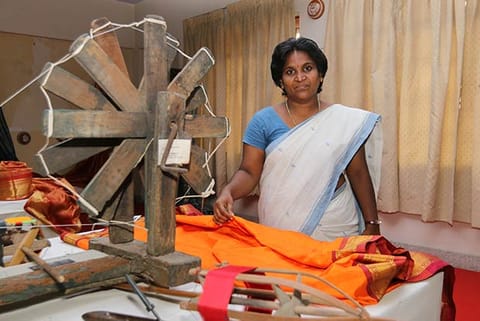
Sasikala is one of the hundreds from Chennai who travel to the neighbouring district of Kancheepuram on work. However, R Sasikala’s journey is different from those of others. Every day, during the one-and-a-half hour bus ride from Maduravoyal to her office near Kancheepuram bus stand, she makes it a point to speak to her co-passengers, mostly women, convincing them to switch to wearing handloom sarees.
“This has been my routine for the last two years, ever since I got transferred to this centre,” says the 35-year-old woman who was wearing a white khadi saree with a simple blue border when we met her. “Anyone who sits next to me during the ride has to endure the long story I spin about the benefits of wearing handloom,” she says. Working as the Assistant Director (design) at the Weavers’ Service Centre (WSC) in Kancheepuram, Sasikala says she finds it hard to not talk to others about indigenous textiles.
“I used to educate my family and friends, but when I started travelling by bus, I thought, why not take the message across to the general public too,” she says. Her efforts have yielded some gratifying results: many have switched over, but not before getting their questions on the price differential in handloom versus polyester answered, and also why the cheaper synthetic alternatives available won’t do.
“The people I talk to are government staff, teachers and other frequent travellers. I tell them about the service they do to the families of weavers by buying handloom and the reason why our silk and cotton have been considered the best, even by our ancestors. Many of these handloom sarees were passed on to the next generation as heirlooms; and it was possible because of their durability. But we can’t do the same with cheaper options, I tell them. There are other interesting questions that come up — aren’t pattu and jari the same? How is handloom different from powerloom?” she says.
It is not just women but also men, who get to hear lessons on handloom. “The other day, I suggested to a bank employee, whom I see on the bus every day, to buy silk sarees from Kancheepuram for his wife for the upcoming festivals. He and his entire family bought sarees worth Rs 80,000 from one of the weavers’ societies here,” she says exultantly. An alumnus of the Government College of Fine Arts, Chennai, from where she completed her BFA and MFA (textile design), Sasikala believes she was ordained to pursue a career in textiles.
“I have grown up seeing my mother, who was with an export concern, sampling fabrics. I often wondered how those fascinating prints and designs were made. She told me all one needed was creativity. After completing the courses, I worked in handicrafts and handlooms, undertaking projects. I joined the WSC in 2013 in Hyderabad, where I worked for a year,” she says. Living by her own example, Sasikala wears mostly cotton sarees — from Bengal to Andhra. “I think that’s the best way to spread the message. I show them how rich and varied sarees can be,” she says. It has not been easy, she adds, pointing out that it is natural for people to assume that she is being pushy or has vested interests.
“When people ask me if I get a commission for promoting handloom, I laugh this off. I tell them I take the credit for spreading the awareness on our country’s riches. These efforts are to make people understand the role weavers play in our lives and culture. If they don’t thrive, tomorrow, handloom sarees will become a thing of the past. Kanchi cotton sarees don’t find many takers from weavers because it is labour-intensive to create them. Similarly, the authentic gold jari is not made any more because of the skyrocketing gold price. Kancheepuram silk, however, will be in demand as weavers and connoisseurs have both promoted it keenly,” she points out.
Visit news.dtnext.in to explore our interactive epaper!
Download the DT Next app for more exciting features!
Click here for iOS
Click here for Android