
- Chennai
- Tamil Nadu
- India
- World
- EntertainmentEntertainment
- Business
- Sports
- Lifestyle
- Technology
- Videos
- Explainers
- Editor's Picks
DANICA KIRKA, LORNE COOK & STEFANIE DAZIO
WASHINGTON: Greenland’s position above the Arctic Circle makes the world’s largest island a key part of Western security strategy. Increasing international tensions, global warming, and a shifting global economy have placed Greenland at the centre of trade and security debates. US President Donald Trump wants to ensure his country controls this mineral-rich island, which guards the Arctic and North Atlantic approaches to North America.
Trump’s repeated demands for the territory and threats to take it by force have rattled the NATO alliance and discomfited European allies who have long relied on the US as a partner in their defence. Greenland is a self-governing territory of Denmark, a longtime US ally that has rejected Trump’s overtures.
Greenland’s own government opposes US designs on the island, saying the people of Greenland will decide their own future.
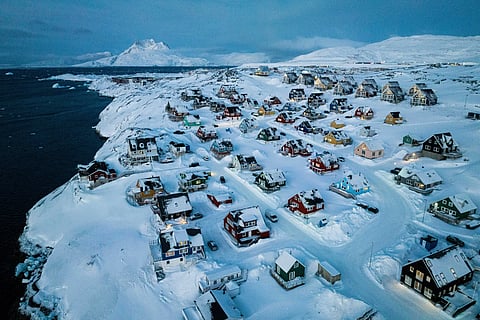
The island, 80% of which lies above the Arctic Circle, is home to about 56,000 mostly Inuit people who until now have been largely ignored by the rest of the world.
Trump has mulled territorial expansion via Greenland, Canada and Venezuela during his second term. But of the three, he comes back to Greenland most often, arguing that it is necessary for US security to be in control of the Arctic island.
“Greenland is very important to the United States, but it’s not important to Denmark,” Trump said Wednesday during a NATO summit. “We need it for the protection of the world, not just the United States.”
Earlier in his term, he would not rule out taking the island by military force to secure its “right, title and ownership,” though the president has since said he’s taken military options off the table.
Trump says the US needs Greenland to deter threats from Russia and China and has repeatedly made false claims of Chinese and Russian military forces lurking off the island’s coastline.
Greenland sits off the northeastern coast of Canada, with more than two-thirds of its territory lying within the Arctic Circle. That has made it crucial to the defence of North America since World War II, when the US occupied Greenland to ensure it didn’t fall into the hands of Nazi Germany and to protect crucial North Atlantic shipping lanes.
Following the Cold War, the Arctic was largely an area of international cooperation. But climate change is thinning the Arctic ice, promising to create a northwest passage for international trade and reigniting competition with Russia, China and other countries over access to the region’s mineral resources.
In 2018, China declared itself a “near-Arctic state,” planning a “Polar Silk Road” under its global Belt and Road Initiative. Washington rejected the move, warning against transforming the Arctic Ocean into a militarised zone fraught with competing territorial claims. Meanwhile, Russia has aggressively asserted its influence, boosting its military presence, restoring Soviet-era infrastructure, and opening several polar bases since 2014. Russian President Vladimir Putin has warned that Moscow will counter expanding NATO activities in the region.
The US military already maintains a significant foothold on the island. The Department of Defence operates Pituffik Space Base in northwestern Greenland, established under a 1951 defence treaty with Denmark. The base supports missile warning, missile defence, and space surveillance for the US and NATO. Greenland also guards the GIUK (Greenland, Iceland, United Kingdom) Gap, a critical maritime choke point where NATO monitors Russian naval movements.
However, military experts question whether an outright American takeover would improve Washington’s strategic position. Thomas Crosbie, an associate professor at the Royal Danish Defence College, noted that the US already enjoys all the strategic access it needs as a trusted ally. “The United States will gain no advantage if its flag is flying in Nuuk versus the Greenlandic flag,” Crosbie said.
While Denmark’s parliament recently expanded military agreements to allow US troops broader access to Danish air bases, diplomatic red lines remain. Danish Foreign Minister Lars Løkke Rasmussen clarified that Denmark maintains the right to terminate these defence agreements if the U.S. attempts to annex any part of Greenland.
Beyond security, Greenland holds massive deposits of rare earth minerals essential for cellphones, computers, and green energy batteries. Western powers are eager to develop these resources to counter China’s current dominance in the critical minerals market. However, tapping into this wealth remains a logistical challenge due to Greenland’s harsh climate and strict environmental controls.
