
- Chennai
- Election-2026Election-2026
- Tamil Nadu
- National
- World
- Cinema
- Business
- Sports
- Lifestyle
- Technology
- Videos
- Explainers
Young athletes in northern Ukraine spend their days cross-country skiing through a scorched forest, focused on their form — until a siren inevitably shatters the silence.
They respond swiftly but without panic, ditching their skis and following coaches to an underground bomb shelter.
It’s an ordinary training session at the complex that produced Ukraine’s first Olympic medalist.
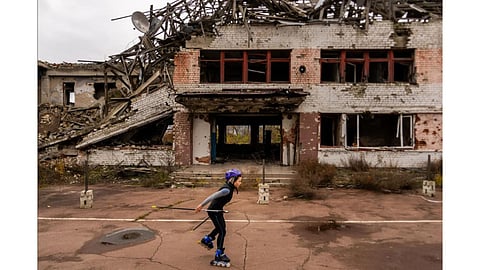
Sleeping children no longer dream of Olympic glory in the facility’s bombed-out dormitories, and unexploded ordnance has rendered nearby land off limits.
But about 350 kids and teens some of the nation’s best young cross-country skiers and biathletes still practice in fenced-off areas amid the sporadic buzz of drones overhead and explosions as they’re shot down.
“We have adapted so well — even the children — that sometimes we don’t even react,” said Mykola Vorchak, a 67-year-old coach. “Although it goes against safety rules, the children have been hardened by the war. Adapting to this has changed them psychologically.”
War has taken a heavy toll on Ukrainian sport. Athletes were displaced or called up to fight. Soccer matches are often interrupted by air raid sirens, limiting attendance to bomb shelter capacity. Elite skaters, skiers and biathletes usually train abroad, with attacks and frequent blackouts shuttering local facilities.
Yet the government-run Sports Ski Base of the Olympic Reserve remains open for cross-country skiing and biathlon.
The sprawling complex sits on the outskirts of Chernihiv, a city two hours north of Kyiv, along the path of destruction left by Russia’s 2022 attempt to capture the capital.
Chernihiv remains a regular target for air attacks aimed at the power grid and civilian infrastructure.
Several temporary structures at the sports centre serve as changing rooms, toilets, and coaches’ offices. Athletes train on snowy trails in winter and, the rest of the year, use roller skis on an asphalt track pocked with blast marks.
Valentyna Tserbe-Nesina spent her adolescence at the Chernihiv center performing these same drills and went on to win bronze at the 1994 Winter Games in Lillehammer Ukraine’s first Olympic medal as an independent country.
She was shocked when she visited the complex in 2022. Shelling had torn through buildings, fire had consumed others. “I went inside, up to my old room on the second floor.
It was gone no windows, nothing,” she said. Trophies left behind were burned.
Now 56, Tserbe-Nesina volunteers to organise funerals for fallen Ukrainian soldiers in her hometown while her husband, a retired military officer, serves at the front.
They see each other about once a year.
One adult who completed a tour in a territorial defense unit sometimes trains alongside the youngsters.
Khrystyna Dmytrenko, 26, will represent Ukraine at the Milan Cortina Winter Olympics starting Feb. 6. “Sports can show that Ukraine is strong,” she said. “We represent our unity, strength and determination.”
That is why many Ukrainians view training here as an act of defiance.
Former Olympic biathlete Nina Lemesh said some youngsters who first picked up skis and rifles at the Chernihiv base during wartime have already become international champions in their age groups.
“This is the next generation of Olympians,” she said.
Associated Press