
- Chennai
- Tamil Nadu
- India
- World
- EntertainmentEntertainment
- Business
- Sports
- Lifestyle
- Technology
- Videos
- Explainers
- Editor's Picks
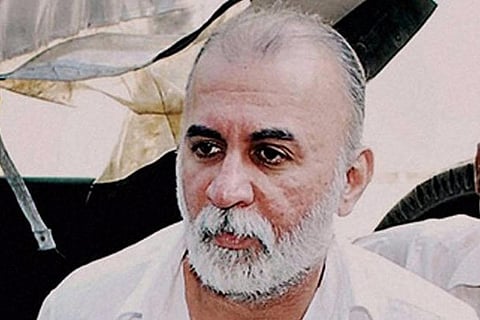
The Bombay High Court on Thursday (Aug 6) convicted former Tehelka editor Tarun Tejpal for rape and sexual harassment of a junior colleague and sentenced him to 10 years in jail. That it took 13 years for the case to reach this stage — eight years of prosecution in a lower court and five years in appeal against acquittal — tells you how slowly the wheels of justice grind in India. That in itself is systemic injustice to survivors of sexual violence; few would be able to stay the course or get the sustained support of the law enforcement and justice systems.
After the sentencing, Tejpal did himself no favours by claiming to be a victim of state vendetta, and worse, placing himself in the company of political prisoners Umar Khalid and Sharjeel Imam. It’s an inappropriate and insensitive comparison that gives us a glimpse into the kind of entitlement felt by privileged Indians of a certain class. To both Khalid and Imam, the state has not allowed even the basic right of a fair trial while keeping them in jail for six years. Tejpal, in comparison, spent a total of seven months in custody before the Supreme Court granted him bail in 2014.
Tejpal was a leading light of India’s liberals and editor of an influential magazine in the years before the Hindutva right captured power in 2014. His case is that the BJP government of Goa, where the offence took place, was vindictive towards him by vigorously appealing against his 2021 acquittal and that the Bombay High Court did not consider evidence that might have exonerated him. However, his conviction was based on substantial electronic evidence produced by the survivor, including the unconditional apology emails he sent to her shortly after the incident expressing shame for a "lapse of judgment". There was also clear CCTV footage establishing the timeline reported by the victim and adequate supporting corroboration by her peers.
Coincidentally, and ironically perhaps, the Tejpal conviction came just three days after former Wrestling Federation of India (WFI) president Brij Bhushan Sharan Singh was let off on charges of sexual harassment levelled by several female wrestlers. Here, the state proved itself to be a reluctant prosecutor unlike its Goa counterpart. The Delhi police dragged their feet over filing an FIR when several star wrestlers, including a minor, came up with their allegations. For months, the BJP government at the Centre remained unmoved by the survivors’ public agitation and allowed the accused to remain in his positions of power as MP and WFI chief. It is justified, and fair, therefore, to demand that Brij Bhushan’s lower court acquittal based on insufficient evidence should be subjected to appeal in the High Court. It is quite common for lower courts to give verdicts fully aware that they will be subjected to review higher up anyway.
The Tejpal and Brij Bhushan cases have insights useful to survivors as well. The woman in the Tejpal case preserved digital and corroborative evidence while the wrestlers relied mainly on oral statements. Also, it helped that the Tejpal survivor reported the allegation to the Tehelka management and police within days, while the wrestlers’ allegations spanned a decade-long window. Both these cases, as well as the MJ Akbar episode, serve to show the way to other survivors.
