
- Chennai
- Election-2026Election-2026
- Tamil Nadu
- National
- World
- Cinema
- Business
- Sports
- Lifestyle
- Technology
- Videos
- Explainers
With conflict disrupting shipping in the Middle East and the future of US tariffs still uncertain, global trade is firmly in the spotlight. But while it certainly matters how these political developments unfold, one must not lose sight of the deeper forces at work in the global economy.
The past year was among the most tumultuous for global trade in living memory, with US tariff rates rising to their highest level in nearly a century and trade between the United States and China one of the world’s largest trading corridors falling by roughly 30%. Yet global trade did not decline. On the contrary, it continued to grow, rerouting in ways consistent with patterns we began measuring three years ago in McKinsey Global Institute research on geopolitically driven shifts in trade.
We find that the world is not “deglobalising” so much as reconfiguring — like water finding new channels. As geopolitical tensions escalate and economic security concerns grow, companies redirect investment and redesign supply chains.
In our latest analysis of 2025 trade flows, what stands out most is how resilient US demand for foreign goods remained. Still, while Americans kept buying from abroad, what they purchased was different. The US imported more chips and data-centre equipment, but fewer autos and less energy. Sourcing shifted from mainland China to Vietnam, Taiwan, and other Asian economies.
It would be natural to assume that tariffs were the driving force behind these and other shifts. But that explanation is incomplete, because the race to develop AI has also emerged as a powerful new factor, accounting for about one-third of the growth in global trade in 2025. This development has received far less attention than AI’s implications for economic growth, financial markets, or jobs, perhaps because much AI-linked commerce is concentrated among geopolitically aligned economies.
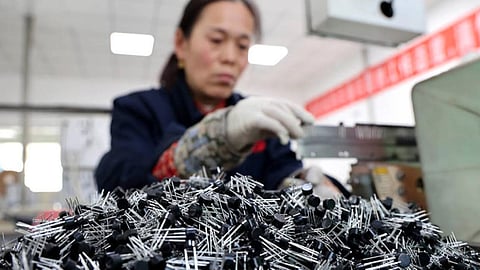
Another underappreciated factor is the extent to which China’s economy has changed. It is still the world’s export engine, but it has leaned further into its role as the “factory to the factories”: a supplier of the machinery and components that power manufacturing elsewhere, particularly in emerging economies. Shipments of Chinese-made industrial inputs rose by more than $175 billion in 2025, led by exports of intermediate goods such as chips or smartphone parts, which grew by 9% — twice as fast as China’s overall exports.
Meanwhile, as access to the US market shrank for some industries, firms sought new markets for consumer goods. To keep volumes growing, exporters of consumer products cut prices by an average of 8%, and these changes cascaded unevenly through regional economies.
For example, the ASEAN region expanded its role as a critical manufacturing hub, creating new connections in the shifting geopolitical landscape. All told, its trade with every major region increased, with exports growing by 14% — more than twice the pace of global trade. At the same time, India captured a large share of US smartphone demand once met by China; and Brazil expanded its commodity exports as China shifted purchases away from the US.
Europe, by contrast, struggled to adjust. The European Union faced intensifying competition from Chinese imports, while higher US tariffs constrained key exports. Excluding a rush of gold and pharmaceutical sales ahead of anticipated tariffs, Europe’s trade balance with the US and China deteriorated by roughly $80 billion. Stronger trade with other markets offset only around half that decline. The strain was especially visible in autos. For the first time ever, Germany, Europe’s auto powerhouse, imported more cars from China than it exported there.
It is understandable that today’s headlines feel like proof that geopolitics now sets the rules of trade. But, again, the story is incomplete. Geopolitics is indeed reshaping the trading map, but longer-term shifts in technology and economic development are determining what the world builds and buys — as the surge in trade linked to the AI boom attests. Amid tariff hikes, legal uncertainty, and growing trade restrictions, firms raced to secure chips and servers, along with cooling systems and the other equipment required to build and power data centres.
Fundamentally, global trade is being reshaped by long-term forces, from technology to shifting production networks and emerging-market growth. Making sense of what comes next requires a broad view that accounts for how these forces interact under different scenarios, rather than focusing on any single disruption.
Of course, geopolitical shocks will remain a feature of the system. The ability to adjust as conditions evolve will matter just as much as long-term positioning in a world where trade is still expanding, but along more contested lines.
Tiago Devesa is a senior fellow at the McKinsey Global Institute in Lisbon.
Jeongmin Seong is a senior fellow at the McKinsey Global Institute in Shanghai.
Olivia White, a senior partner at McKinsey & Company, is a director of the McKinsey Global Institute
Project Syndicate