
- Chennai
- Election-2026Election-2026
- Tamil Nadu
- National
- World
- Cinema
- Business
- Sports
- Lifestyle
- Technology
- Videos
- Explainers
As the United States was preparing a daring mission to rescue an airman whose fighter jet was shot down by Iran, there was money to be made. Users on Polymarket, the world’s largest prediction market, could place bets on when the airman would be rescued. When Rep. Seth Moulton shared a screenshot of the activity on social media, an April 3 rescue was trading at 15% compared with 63% who were betting on April 4.
After Moulton blasted this “dystopian death market,” Polymarket stopped the betting, saying the market “does not meet our integrity standards.” A former Marine who served four tours in Iraq, Moulton said he was “absolutely not satisfied” and blamed the site for being “completely unwilling to self-regulate when it comes to betting on the lives of our service members.” “This is war profiteering and Congress needs to step in and stop it,” he said.
A confrontation is brewing in Washington over prediction markets, the online exchanges that allow users to bet on the outcome of everything from baseball games to geopolitical events. In a highly polarised Congress, the need to guard against these markets being used for insider trading has become rare common ground. Members of both parties pressed the leader of a typically low-profile regulatory agency on the issue during a hearing on Thursday. The market debate is also drawing in the White House, potential presidential candidates and state leaders.
“It’s a national conversation about what it means to have market integrity,” said Kristin Johnson, a former commissioner at the Commodity Futures Trading Commission (CFTC), which regulates prediction markets in the US. In a capital that was slow to respond to the perils of tobacco, opioids and social media, the push to put guardrails on prediction markets has been uncommonly swift.
The markets, which include Polymarket and its chief rival Kalshi, have been criticised for everything from undermining the integrity of sports to contributing to an online betting addiction crisis among young men. Polymarket has come under particular scrutiny as a venue for offshore trades that are beyond the reach of US regulators. Donald Trump Jr. is on Polymarket’s advisory board and is a paid adviser for Kalshi. 1789 Capital, the venture capital firm where Trump Jr. is a partner, has invested in Polymarket.
The Associated Press reported this month that a group of new accounts on Polymarket made highly specific, well-timed bets on whether the US and Iran would reach a ceasefire on April 7, resulting in hundreds of thousands of dollars in profits for these new customers. Earlier this year, an anonymous Polymarket user collected more than $400,000 on a January bet predicting the ouster of Venezuelan President Nicolás Maduro, prompting concerns that someone with access to private US government information may have engaged in insider trading.
Sen. Todd Young, an Indiana Republican and former Marine, said he had been concerned about trading in the sports market, “but I became especially concerned about market distortions, improper decision making, and undermining of public trust through self-enrichment after the news broke about Venezuela.” Young and Sen. Elissa Slotkin have introduced a bill that would bar federal employees from using nonpublic information to make bets on prediction markets. Their bill is among several bipartisan efforts in Congress to regulate prediction markets.
As he eyes a potential presidential campaign, Democrat Rahm Emanuel proposed a ban and a 10% fee on those markets and online gambling to fund science and health research. California Gov. Gavin Newsom issued an executive order barring his appointees from using nonpublic information to trade on prediction markets.
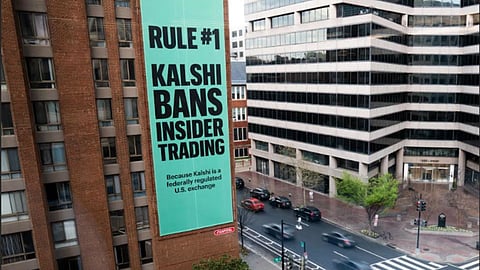
For now, there’s no immediate path to passage for any of the bills. But the scrutiny has drawn focus to the differing approaches of the main prediction markets. Polymarket operates largely offshore with limited functions in the US that were allowed only after President Trump returned to office. Kalshi, meanwhile, says it already bans many of the most extreme betting markets and welcomes regulation.
White House spokesman Davis Ingle said Trump has been clear that “members of Congress and other government officials should be prohibited from using nonpublic information for financial benefit.” As the debate plays out in Washington, multiple states have tried to curtail prediction markets, arguing they are essentially operating as unlicensed gambling platforms. However, the CFTC has responded forcefully to assert itself as the sole regulator, suing Connecticut, Arizona and Illinois this month.
Associated Press