
- Chennai
- Election-2026Election-2026
- Tamil Nadu
- National
- World
- Cinema
- Business
- Sports
- Lifestyle
- Technology
- Videos
- Explainers
For decades, the global perception of the Gulf region has been defined by oil. Tankers, pipelines, and refineries have long been viewed as the most critical and vulnerable assets in the Middle East. Recent strikes on oil depots in Tehran, followed by reports of “black rain” falling for hours, underscore this traditional focus. However, a far more precarious vulnerability is emerging. While oil “shocks” damage economies, a water crisis can destabilise entire societies.
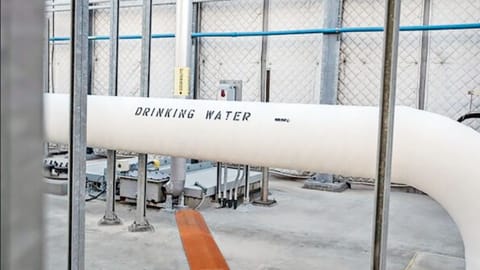
Across the Arabian Peninsula, seawater desalination has transformed some of the driest landscapes on Earth into thriving urban centres. Cities like Dubai, Doha, Kuwait City, and Abu Dhabi are now almost entirely dependent on these plants. Approximately 70% of Saudi Arabia’s drinking water is desalinated, while in Kuwait and Oman, that figure reaches a staggering 90%. Without this technology, modern urban life in the region would cease to exist.
This technological triumph has created a profound strategic weakness. Regional water security rests on a relatively small number of massive coastal installations. Unlike oil terminals, these plants cannot be easily bypassed. They are complex, fixed systems requiring specialised membranes, immense energy inputs, and continuous chemical treatments. Repairing serious damage to such a facility could take months, yet most cities in the region have only a few days of storage capacity.
Current military tensions have already begun to expose this fragility. Missile strikes and drone interceptions have recently occurred near major water and power complexes. Whether through direct intent or proximity, these facilities are increasingly exposed to modern warfare. If a primary plant were disabled, governments would face immediate water rationing for millions. Hospitals, sanitation systems, and food production would be crippled simultaneously.
This risk is magnified by the region’s natural water scarcity. The Middle East is amongst the most water-stressed areas globally, with low rainfall and rapidly depleting groundwater. In Iran, prolonged drought and over-extraction have left dams running dry. Desalination has moved from being a supplementary tool to the very backbone of urban survival. This “desalination dependency” means roughly 100 million people rely on a handful of centralised facilities. Ten of the world’s largest plants are concentrated along the shores of the Gulf and the Red Sea.
History shows that water infrastructure is frequently caught in the crossfire. From Iraq and Syria to Yemen, pumping stations and reservoirs have been systematically damaged. International law, specifically Article 54(2) of the Geneva Conventions (Protocol I), strictly prohibits attacks on drinking water installations indispensable to the survival of civilians. These protections are designed to prevent the starvation or forced displacement of populations, regardless of the military motive.
The humanitarian fallout of disabling these plants would be catastrophic. Urban water systems are highly localised; if a plant serving a metropolitan area is hit, there are no immediate alternatives. Emergency water tankers could provide only a fraction of the necessary daily output. Beyond thirst, the failure of sanitation systems would trigger public health crises and halt economic activity in tourism, industry, and services—the pillars of modern Gulf economies.
The geopolitical implications extend globally. The Gulf is a testing ground for infrastructure vulnerability in an era of climate stress. As water scarcity intensifies, coastal megacities from California to Australia are investing heavily in similar large-scale desalination. How these facilities are protected—or targeted—in the Middle East will set a precedent for the rest of the world.
To mitigate these risks, regional states could pursue diversification strategies. Expanding wastewater recycling, replenishing natural aquifers, and moving toward “distributed desalination”—smaller, decentralised plants spread across multiple locations—would reduce reliance on single, high-value targets. Increasing strategic storage capacity would also provide a necessary buffer against sudden disruptions.
However, technical fixes are only part of the solution. There must be a global diplomatic recognition that these plants are critical humanitarian infrastructure. In the 20th century, oil built the cities of the Gulf. In the 21st century, it is desalinated water that keeps them alive. Protecting these lifelines is no longer just a regional priority; it is a fundamental requirement for societal survival in an increasingly thirsty world.
The Conversation