
- Chennai
- Tamil Nadu
- India
- World
- EntertainmentEntertainment
- Business
- Sports
- Lifestyle
- Technology
- Videos
- Explainers
Tamil Nadu’s plan to expand artificial intelligence education across government schools is not merely a curricular update. It is a decision about who will possess power in an economy increasingly governed by algorithms.
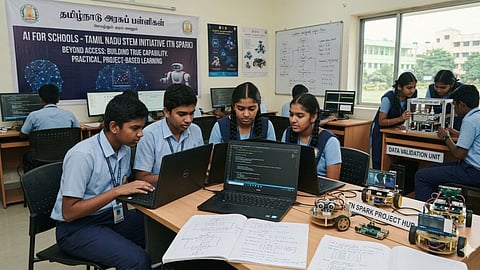
Under the TN SPARK programme, emerging technologies are already being piloted in nearly 5,000 government schools. The state now proposes extending the curriculum across Classes 6–8, followed by textbooks for Classes 9–10 and, later, Classes 11–12. Bilingual materials, practical projects and teacher training are built into the roadmap. Its wider influence could eventually reach more than 60 lakh State Board students.
The ambition is commendable. But scale should not be mistaken for success. The real question is whether Tamil Nadu can convert technological exposure still disproportionately available to affluent children into a genuine public capability.
Tamil Nadu is entering a global educational race that has already moved beyond teaching children how to use computers.
China is constructing an integrated AI literacy system spanning primary school, secondary level and higher education. Younger children encounter AI through activities; middle-school students apply it to everyday problems; older students move towards experimentation and innovation. Importantly, China treats rural access, national digital platforms, teacher preparation and curriculum design as parts of the same system.
The United States follows a more decentralised path, but its long-running STEM strategy connects schools with universities, laboratories, employers and research funding. STEM education is treated not as an isolated school subject but as the foundation of innovation, productivity and strategic competitiveness.
The contrast carries a warning. China is building an AI education system. The United States is sustaining a STEM ecosystem. Tamil Nadu must avoid creating merely another syllabus.
A computer laboratory is not technological empowerment. A child may learn to generate an image, enter a prompt or reproduce a definition of machine learning without understanding how an algorithm reaches a conclusion or why that conclusion may be wrong.
Access means placing a device before a student. Capability means enabling that student to question an output, detect fabrication, protect personal information, recognise bias and decide when technology should not be trusted.
That distinction will determine whether TN SPARK narrows inequality or digitises it. A well-resourced urban school with stable internet, trained teachers and technical support cannot be equated with a rural school where connectivity fails, equipment remains locked, and teachers already carry excessive workloads. Sending both schools the same textbook creates administrative equality, not educational equality.
The success of the programme, therefore, cannot be measured by the number of schools “covered”. It must be measured by what students can independently, critically and ethically do.
Artificial intelligence changes faster than school curricula. A programme centred on particular applications, commercial platforms or prompt-writing techniques may become obsolete before students complete their education.
Schools must teach durable foundations instead: logical reasoning, computational thinking, statistics, data literacy, verification and problem-solving. Students should understand that AI does not “know” in the human sense. It predicts patterns from data; those data may be incomplete, discriminatory or deliberately manipulated.
Ethics cannot be confined to a ceremonial final chapter. Questions of privacy, surveillance, intellectual property, misinformation, automation and accountability must run through the curriculum. Tamil Nadu must also resist curriculum overload. AI should not displace reading, writing, mathematics or scientific reasoning. Generative tools are most dangerous in the hands of learners who lack the foundational knowledge required to challenge them. AI literacy without basic literacy does not produce empowered students; it produces sophisticated dependence.
India’s examination culture can convert even the most innovative subject into memorised notes. If students are asked to define algorithms, list the uses of AI or reproduce model answers, an ambitious reform will become rote learning in digital clothing.
Assessment must instead test judgement. Students could use data to examine local water consumption, transport delays, crop conditions or waste management. They should then explain the quality of the data, limitations of the model, possible biases and decisions that must remain human.
The objective is not to produce teenage software engineers. It is to cultivate citizens who can use technological tools without surrendering their reasoning to them.
The roadmap will soon expose the inertia of higher education. Universities cannot offer an optional AI paper while leaving economics, law, medicine, management, public policy and the humanities untouched.
Algorithms already influence recruitment, credit, diagnosis, policing, insurance and welfare delivery. Future doctors must understand automated diagnosis; lawyers, algorithmic evidence; economists, data-driven exclusion; and public officials, the accountability risks of automated governance.
Tamil Nadu’s labour market may benefit from students who arrive with technological fluency. But employability cannot mean preparing children for today’s software. The more enduring skill is adaptability: the capacity to learn, unlearn and exercise judgement when technologies and jobs change.
Tamil Nadu has made the right wager, but its implementation must be publicly auditable. Connectivity, functioning laboratories, teacher readiness, rural participation and learning gaps across gender and social groups must be tracked, not presumed. The roadmap will succeed not when every child learns to speak to a machine, but when every child learns when and why the machine must be questioned to remain intellectually independent of them.
Debdulal Thakur is Professor, Department of Economics, Alliance University, Bengaluru
