
- Chennai
- Tamil Nadu
- India
- World
- EntertainmentEntertainment
- Business
- Sports
- Lifestyle
- Technology
- Videos
- Explainers
- Editor's Picks
Preventive powers may be necessary to protect public safety, but when exercised arbitrarily against peaceful protesters, they threaten personal liberty, constitutional freedoms, and the democratic right to dissent. A democracy is tested not merely by the laws it enacts but by the restraint with which it exercises power.
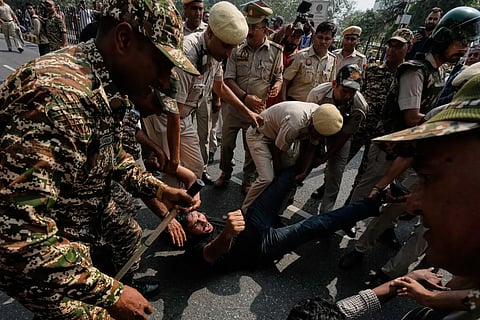
The authority to govern does not confer unlimited authority to control citizens, nor does maintaining public order permit the government to treat disagreement as a threat. Preventive detention raises a fundamental constitutional question: how can a government protect public safety without undermining the liberty it must safeguard? Recent detentions surrounding protests in Delhi have renewed concerns about restricting individual liberty before an anticipated offence occurs.
The British administration frequently justified extraordinary coercive powers through arguments about security and public order. The Rowlatt Act of 1919 extended exceptional powers to the colonial government, provoking widespread opposition and a nationwide satyagraha led by Mahatma Gandhi. Independent India adopted a Constitution guaranteeing fundamental rights and judicial review. Article 21 provides that no person shall be deprived of life or personal liberty except according to procedure established by law. Article 22 establishes safeguards concerning arrest and detention while permitting preventive detention under a distinct framework.
However, constitutional recognition does not make every exercise of preventive power lawful or immune from judicial scrutiny. Preventive detention carries particular risks because it rests on anticipated danger. Suspicion may substitute for evidence, apprehension for necessity, and administrative convenience for constitutional justification.
In Rekha v. State of Tamil Nadu (2011), the Supreme Court described preventive detention as repugnant to democratic ideas and anathema to the rule of law. It emphasised that when ordinary criminal law is sufficient, preventive detention may be illegal. Detention must not become a convenient alternative to criminal proceedings simply because authorities find it easier than establishing a case through ordinary legal procedures. Similarly, in Khudiram Das v. State of West Bengal (1975), the Supreme Court held that executive satisfaction in ordering preventive detention was not wholly immune from judicial review.
Courts could examine whether authorities had applied their minds, acted in good faith, relied on relevant material, and exercised their powers for legally permissible purposes. In Maneka Gandhi v. Union of India (1978), the Court established that procedures depriving individuals of personal liberty must be just, fair, and reasonable rather than arbitrary. Together, these judgments affirm that preventive detention must remain legally justified, exceptional, and subject to judicial scrutiny. It cannot become punishment imposed without the safeguards of a criminal trial.
The Constitution protects freedoms essential to public dissent. Article 19(1)(a) guarantees freedom of speech and expression, while Article 19(1)(b) protects peaceful assembly without arms. Although these freedoms are subject to reasonable restrictions, the right to protest is not a privilege the government may withdraw whenever demonstrations become politically inconvenient. In Himat Lal K Shah v. Commissioner of Police, Ahmedabad (1973), the Supreme Court recognised the importance of public meetings while acknowledging the state's authority to regulate them. The distinction is between reasonable regulation and arbitrary suppression. In the Ramlila Maidan Incident (2012), the Court examined police action against a gathering in Delhi, emphasising the constitutional significance of peaceful assembly and the need for police powers to remain subject to legal scrutiny. Similarly, in Mazdoor Kisan Shakti Sangathan v. Union of India (2018), concerning restrictions on demonstrations in central Delhi, including Jantar Mantar, the Court recognised peaceful protest as a fundamental right while acknowledging the need to balance demonstrations with public order and competing rights. The government may impose lawful and reasonable conditions, but it cannot treat dissent itself as sufficient justification for suppression. Government cannot recognise peaceful assembly in theory while discouraging its exercise through arbitrary detention, prohibitions, or excessive police action.
The right to protest becomes vital when citizens question unjust or flawed policies. Democracy provides a framework for competing political beliefs, social experiences, and understandings of justice to be expressed and contested. The problem arises when criticism is treated as disloyalty, opposition to government policy is confused with enmity toward the nation, and peaceful demonstrations are viewed as threats simply because they challenge authority. An electoral victory confers the authority to govern within constitutional limits; it does not give the government ownership of the Republic. Citizens retain the right to question decisions, demand explanations, and challenge public authority after elections through constitutional means. When citizens seek accountability, their allegations may be disputed and their demands contested. Such disagreements must be addressed through evidence, legal procedures, and democratic debate. The appropriate response is to examine evidence, explain decisions, and provide accessible mechanisms for accountability, not automatically resort to detention. The Bharatiya Nagarik Suraksha Sanhita (BNSS) provides specific powers for preventive police action, but these must be exercised as per statutory requirements and constitutional constraints. The government must distinguish between preventing genuine threats and restricting peaceful political expression.
India’s colonial history warns against using the language of public order to justify unchecked state overreach. The Constitution establishes fundamental rights, legal safeguards, and judicial review precisely to ensure authority remains strictly limited. While peaceful protests may inconvenience the state and demand difficult answers, such friction never justifies state detention. Suppressing demonstrations fails to resolve the grievances that drive citizens into public spaces. A democracy cannot preserve public order by intimidating its populace. Preventive detention must serve to stop explicitly criminal behaviour, not suppress the legitimate exercise of free speech and assembly. The power to detain must be balanced with the right to dissent. A democracy validates its governance not by how efficiently it silences disagreement, but by how faithfully it protects the liberty of its political critics.
Akhilesh Kumar is a PhD Research Scholar at Jamia Millia Islamia, New Delhi, and an independent writer
