
- Chennai
- Tamil Nadu
- India
- World
- EntertainmentEntertainment
- Business
- Sports
- Lifestyle
- Technology
- Videos
- Explainers
- Editor's Picks
Michael JI Brown
This week, on the eve of the Thanksgiving holiday, the United States Federal Communications Commission approved SpaceX’s plan to launch one million “Starmind” artificial intelligence (AI) data centre satellites. The decision reflects a satellite boom, an AI bubble and the Trump administration’s looser environmental approach.
If Starmind proceeds in full, the number of operational satellites will increase 50-fold. Space and our night skies will become vastly busier places. Its effects would reach beyond orbit.
SpaceX’s pitch is to move the impact of data centres away from Earth, using a million solar-powered satellites to process AI data in space and beam the results to Earth. What would be their impact, and will that many actually reach orbit?
We are already in a satellite boom, with constellations of hundreds or thousands of satellites becoming common. SpaceX’s Starlink internet satellites are the best-known example. Rocket launches have increased to almost one a day, while operational satellites approach 20,000.
But Starmind is unprecedented in scale. To put so many satellites into orbit would be a vast undertaking. If each has a five-year lifetime, similar to Starlink satellites, roughly 500 would need to be launched every day.
That also means disposing of about 500 satellites daily. For satellites less than 2,000 kilometres above Earth, disposal usually means re-entry and burning up in the atmosphere — with consequences.
As satellites burn up, their materials react with and are deposited in the upper atmosphere. Satellites are now depositing far more aluminium, titanium, copper and lead there than the natural quantities arriving from meteors.
Aluminium is of particular concern. Alumina can contribute to the destruction of ozone in the upper atmosphere, potentially increasing ultraviolet radiation reaching Earth and the risk of skin cancer.
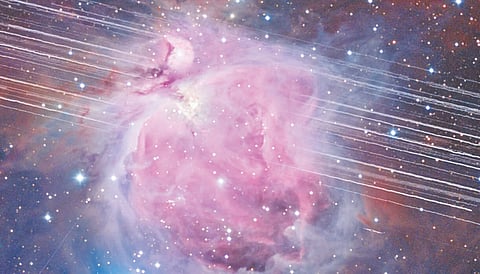
A 50-fold increase would change our view of the sky. Look up in the early evening, and you will see the stars your ancestors saw. Within minutes, a satellite may cross the sky, silently moving from horizon to horizon.
Our view of the night sky could fundamentally change. Each satellite would be 75 metres wide and, in the early evening, brighter than any star. With a million in orbit, hundreds of Starmind satellites could be above the horizon wherever you are.
Orbital clutter also brings real risks. Satellites travel at roughly seven kilometres per second. Collisions can produce clouds of debris, triggering further collisions. The nightmare scenario is Kessler Syndrome: a runaway cascade of debris and collisions that renders low Earth orbit unusable.
SpaceX is aware of collision risks and already manoeuvres Starlink satellites away from potential collisions. But such manoeuvres require functioning satellites, and some will inevitably fail. Uncontrolled satellites would pose a real danger.
The Federal Communications Commission has been a key regulator of US satellites, overseeing radio frequencies used for communications, end-of-life disposal and environmental impacts.
Under the Trump administration, however, the commission has adopted a looser approach. Its Starmind decision reflects this, stating it “will not require further environmental review under the National Environmental Policy Act […] for SpaceX’s Starmind system”.
Some of the commission’s statements are bizarre. It claims the project “promises to bring the human race closer to a Kardashev II civilisation – one that can harness the full power of the sun”.
This is science-fiction silliness. A Kardashev II civilisation would require many trillions of square kilometres of technology in orbit around the Sun. Starmind is no stepping stone to a vast “Dyson sphere”, a hypothetical megastructure that would surround the Sun and capture its energy.
Data centres are unpopular on Earth partly because they consume precious resources, including water for cooling. Cooling in space is harder. In a vacuum, heat can only be radiated away; as vacuum flasks demonstrate, this can be a slow process.
Satellites routinely manage heat, but they do not usually generate it at the rate data centres do. Google recently launched an AI demonstrator satellite and tasked it with carrying out calculations. It had to pause between calculations to dispose of excess heat.
Then there is the financial question. Investment in the current AI boom vastly exceeds revenues, while deploying AI in orbit would cost far more than equivalent computing on Earth.
If the AI boom is a bubble, its eventual burst could bring Starmind back down to Earth.
Brown is Associate Professor in Astronomy, Monash University
The Conversation
