
- Chennai
- Tamil Nadu
- India
- World
- EntertainmentEntertainment
- Business
- Sports
- Lifestyle
- Technology
- Videos
- Explainers
- Editor's Picks
Some of the universe’s most extreme explosions leave almost no trace. The initial blast goes unseen, but astronomers can detect the long-lived echo it leaves behind as a shock wave moves through space.
In new research accepted for publication in The Astrophysical Journal, scientists report what may be the clearest example yet of such a hidden event: the radio afterglow of a powerful gamma-ray burst whose original explosion went unnoticed.
Another possible explanation remains — a rare event in which a star is torn apart by an intermediate-mass black hole, a long-hypothesised but elusive class of black holes. Either way, the observation captures the aftermath of one of the most extreme events the cosmos can produce.
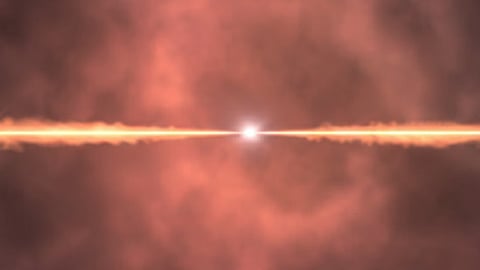
Gamma-ray bursts are brief but extremely energetic jets of radiation. In seconds, they can release as much energy as the Sun will emit over its entire lifetime, usually when massive stars collapse and form black holes.
These jets spread in many directions, but astronomers detect only those pointed toward Earth. When the jet is directed away from us, the initial flash is missed, leaving only a fading afterglow visible later in radio wavelengths.
Such “orphan afterglows” have long been predicted but rarely observed. Without the initial burst to signal their presence, astronomers must scan vast areas of the sky to identify them.
Using the Australian SKA Pathfinder (ASKAP), a 36-antenna radio telescope in Western Australia, researchers surveyed large regions of the sky for unusual radio signals that evolve over weeks or years.
In one survey, they detected a new radio source — ASKAP J005512-255834 — that had not been seen before. It brightened quickly, emitting about 10³² watts of energy, comparable to the radio output of billions of Suns, and then slowly faded.
This behaviour stood out. Many radio transients change quickly or flare repeatedly, but this source appeared to be the lingering echo of a single powerful explosion. It was also visible mainly in radio wavelengths, with little signal in visible light or X-rays — a key sign of an orphan afterglow.
The source lies in a small, bright galaxy about 1.7 billion light-years from Earth that is actively forming stars, an environment where violent stellar events can occur.
Researchers ruled out several possibilities, including pulsars and supernovae. The remaining explanations are either an orphan gamma-ray burst afterglow or a star disrupted by an intermediate-mass black hole — both extremely rare phenomena.
The discovery suggests that many such hidden explosions may still be waiting to be found through radio surveys, offering a fuller picture of how gamma-ray bursts occur across the universe.
The Conversation
