
- Chennai
- Tamil Nadu
- India
- World
- EntertainmentEntertainment
- Business
- Sports
- Lifestyle
- Technology
- Videos
- Explainers
- Editor's Picks
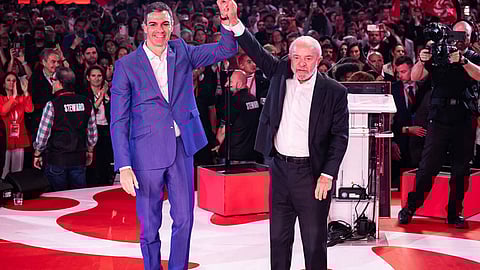
The recently concluded Global Progressive Mobilisation meeting in Barcelona brought together political leaders, policymakers, and activists from around the world, united by a shared concern: democracy is under attack. Spanish Prime Minister Pedro Sánchez described it as a collective effort to confront the global rise of authoritarianism, while Brazilian President Luiz Inácio Lula da Silva called for rebuilding multilateralism and “putting social justice back at the centre of the global agenda.”
Beyond these declarations, the gathering pointed to an emerging consensus that defending liberal democracy requires rethinking its economic foundations. As Lula observed, democracy cannot survive unless it improves people’s living standards.
Underlying that sentiment is the recognition that our current economic system—based on free markets, limited government intervention, and the primacy of individual choice—has failed to deliver shared prosperity or sustain democratic governance. Increasingly, its survival depends on coercion and authoritarian practices. A pro-democracy discourse that seeks to preserve the status quo, therefore, risks deepening the crisis.
The prevailing economic model has eroded stable employment, weakened labour protections, and privatised core public services, leaving large segments of society exposed and vulnerable. For many, this has meant precarious work, rising living costs, and diminished prospects. The result has been not just economic hardship, but also a profound sense of abandonment and resentment.
This economic discontent has had far-reaching political consequences. When liberal democracy fails to provide material well-being, social protections, and a sense of fairness, anti-democratic forces, particularly on the far right, channel popular frustration and anger toward migrants, minorities, and imagined enemies. At the same time, authoritarian movements present themselves as vehicles for advancing economic agendas that no longer rely on workers’ consent, but on coercion.
At the heart of this failing model lies the powerful myth that markets are neutral arbiters of merit, rewarding individuals according to effort and talent. Inequality is treated not as a problem but as a driver of efficiency and innovation. Yet as income and wealth disparities widen and opportunities narrow, the narrative begins to unravel, with people increasingly questioning how economic rewards are divided and losing confidence in the fairness of the rules of the game.
To defend democracy, we must move beyond treating the symptoms and address the underlying causes of today’s crisis. During its G20 presidency, South Africa has taken an important step in this direction by convening the Extraordinary Committee of Independent Experts on Global Inequality, chaired by Nobel laureate economist Joseph Stiglitz. Treating inequality as a systemic risk to both economic stability and democracy, the Committee has proposed the creation of a permanent international body to support coordinated global action.
Modelled on institutions like the Intergovernmental Panel on Climate Change, such a body could consolidate evidence, track global trends, and shape policy debates. It could also serve as a platform for coordination among governments, international organisations, and civil society, complemented by national inequality panels that translate global insights into country-specific strategies. These efforts should include systematic assessments of the distributive impact of public policies, close monitoring of labour-market dynamics—particularly those associated with technological change—and regular public reporting, enabling policymakers to translate analysis into sustained, collective action.
Delivering on this agenda requires a structural shift toward fair and inclusive labour markets. Strong minimum wages, stable employment, and collective bargaining are not merely policy instruments; they are democratic institutions that ensure individual security and agency. More broadly, rebuilding democracy requires restoring the state’s role in providing essential public goods such as education, health care, and housing. These investments can be funded through tax reform, which remains one of the most powerful tools for reducing income and wealth inequality and, ultimately, for determining how economic gains are shared.
The transition to a just economy demands a new development model that aligns economic progress with social inclusion and environmental priorities. For too long, the idea of economic planning has been dismissed as outdated. But development is a deliberate political project, not the inevitable outcome of well-functioning markets. Public investment and industrial policy are critical for shaping sustainable economies and directing resources toward collective goals rather than narrow private interests.
By advancing a clear and compelling alternative to prevailing policy priorities, the Global Progressive Mobilisation offers a unique opportunity to move beyond rhetoric and advance an economic model that reduces inequality, protects the planet, strengthens public institutions, and restores the material foundations of democratic life. The answer to the ongoing resurgence of authoritarianism is not to patch up a broken system, but to embrace a bold, unifying progressive vision.
Democracy cannot survive on procedures alone. It needs a foundation of equality, security, and shared prosperity. Otherwise, we end up where we are now.
(Pedro Rossi is Vice President and Chief Economist of the Global Fund for a New Economy)
Project Syndicate
