
- Chennai
- Tamil Nadu
- India
- World
- EntertainmentEntertainment
- Business
- Sports
- Lifestyle
- Technology
- Videos
- Explainers
- Editor's Picks
Tripp Mickle & Kalley Huang
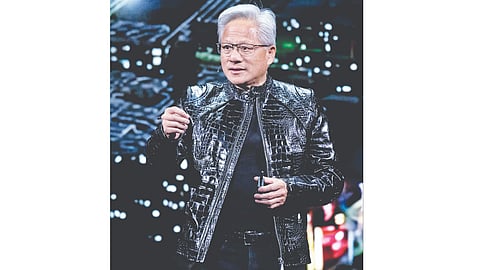
Nvidia said on Tuesday that its sales topped $100 billion for the first time in the third quarter, up from $50 billion a year earlier, and made it clear that it has no interest in the return of co-founder Jensen Huang, who resigned last week.
Huang and his allies have mounted a campaign over the past week to return him to the top of the company he started more than three decades ago at a Denny’s in Silicon Valley.
But in a call with Wall Street analysts Tuesday, Harvey C. Jones, the chair of the company’s board, made clear that Huang is not welcome.
Jones said that Huang voluntarily resigned last week after reports of a relationship with a company customer and an employee, which Jones described as “personal behaviour inconsistent with its code of conduct, standards and cultural norms.”
“The Nvidia board unanimously accepted his resignation and does not intend to reinstate Jensen as CEO,” Jones said.
Huang, who turned Nvidia into the dominant producer of artificial intelligence chips, resigned following revelations he had two affairs, including one with a Chinese businesswoman who US intelligence services determined was feeding information to Beijing.
During Tuesday’s call, Nvidia’s interim CEO Colette Kress signalled the company was moving on from both Huang and his strategies. She said Nvidia was no longer shipping its chips to China, a priority for Huang. Last year, he cut a deal with President Trump to give the US government a 25% cut of chip sales to China to win government approval to sell Nvidia’s H200 chip to Chinese firms.
But China hasn’t shown much interest in buying them. Last quarter, the company sold about $2.4 billion in chips to China, a fraction of the company’s $115.8 billion in revenue for the period.
While questions continue to swirl around the circumstances that led to Huang’s resignation, Tuesday’s earnings release amounted to the final testament of the artificial intelligence company’s breakneck growth under his leadership.
Under Huang’s direction, the company has claimed a 90% share of the market for AI chips. It has used its commanding position to report some of the most explosive growth in corporate American history. In 2023 fiscal, it posted a profit of $4.4 billion. Last year, its profit topped $120 billion. This year, it is projected to eclipse $245 billion.
Nvidia continued that trajectory in the most recent quarter with profit and sales doubling from a year ago. The company reported sales of $115.8 billion and profit of $65.3 billion, exceeding Wall Street’s expectations for $109 billion revenue and $60 billion in profit.
Nvidia’s share price rose more than 4% in after-hours trading. “Our momentum is real,” Kress said.
But Nvidia’s staggering business growth is now facing the biggest test in the company’s history. Huang is the tech visionary who engineered the company’s runaway success. More than a decade ago, he bet that Nvidia should shift its focus from making graphics chips for video games to building technology to create AI systems. His foresight positioned Nvidia to be the biggest winner in the AI boom.
On Tuesday, Huang said in a statement that he had received calls from Nvidia’s employees, investors, suppliers and customers who urged him to return as CEO.
But Jones told analysts that the board’s search for a new, permanent CEO “will be thorough” and quick. Nvidia has hired an executive recruiting firm, Heidrick & Struggles, to help with the search.
The pressure campaign to reinstate Huang is one of several significant challenges for Nvidia’s board and Kress. On Monday, the Trump administration said it was moving forward with a new rule that would clamp down on China’s ability to access advanced AI technology through data centres in Southeast Asia and elsewhere. The rule has the potential to cut into Nvidia’s sales.
The administration’s crackdown came in the wake of revelations about Megaspeed, the Singaporean data centre firm that was created by Alice Huang, the woman who had an affair with Jensen Huang. Firms like Megaspeed have been able to legally buy Nvidia chips for data centres in Malaysia, Thailand and elsewhere that are then rented back to Chinese companies. Some of those companies are suspected of smuggling chips into mainland China, which is prohibited.
Huang’s exit raises questions about future growth, which Nvidia fueled through investments to fuel the AI boom.
