
- Chennai
- Tamil Nadu
- India
- World
- EntertainmentEntertainment
- Business
- Sports
- Lifestyle
- Technology
- Videos
- Explainers
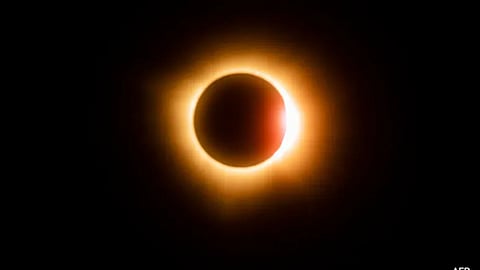
The Moon crossed the Sun’s path on February 17, causing what is known as an annular solar eclipse. The Sun was not covered completely, but the Moon blocked enough of its light to leave a fiery ring. Unless you’re deep in the southern hemisphere, you probably did not notice.
Astrologically speaking, eclipses are said to have effects regardless of who is watching. In astrology, an ancient tradition lacking scientific grounding, eclipses are regarded as powerful and politically significant celestial events. They are traditionally linked to the destiny of rulers – and some astrologers think Donald Trump is no exception.
Astrologers interpret eclipses through horoscopes, celestial maps that place the Sun, Moon and planets within the 12 Zodiac signs. During this eclipse, the Sun and Moon were at the edges of Aquarius, a position astrologers associate with endings and shake-ups.
Alongside other factors, including Trump being born during a lunar eclipse in 1946, some astrologers suggest the eclipse could signal a severe crisis for the US president, even his death. Predictions of this sort appear frequently, and Trump has outlasted many before. Yet such forecasts follow a very old script. For thousands of years, eclipses have been treated as political events and read as omens about kingdoms and rulers.
Eclipses have been linked to the fate of rulers since at least ancient Mesopotamia around 4,000 years ago. Observers there kept lists of phenomena believed to signal particular outcomes. Many omens faded over time, but one endured: if there is an eclipse, the king will die.
With such stakes, ancient astronomers developed systematic observation, record-keeping and calculation to predict eclipses more accurately. This supported the “substitute king” ritual, in which rulers temporarily appointed a replacement until the eclipse passed.
The association spread widely across the ancient world. Egyptian papyri show evidence of it, and Greek and Roman records frequently connected eclipses with notable deaths. Roman historian Cassius Dio described a solar eclipse around the death of Emperor Augustus in AD14, during which “most of the sky seemed to be on fire”. In the gospels of Matthew, Mark and Luke, the death of Jesus is also marked by a darkened Sun.
During the medieval period, Arabic chroniclers often recorded eclipses alongside the deaths of rulers. In Europe, a solar eclipse in 1133 became closely associated with the death of England’s King Henry I in 1135 and came to be known as “King Henry’s Eclipse”.
Premodern rulers commonly hired astrologers to interpret their birth charts. Astrologers were expected to highlight signs justifying authority and predicting long reigns.
Roman historian Suetonius recounts how the astrologer Ascletarion predicted Emperor Domitian’s downfall and was executed for it. More than 1,400 years later, an Oxford astrologer was executed for predicting the death of King Edward IV. In 1581, Queen Elizabeth I made it a felony to use horoscopes to predict her death or successor. Similar prohibitions appeared in France and Italy, where predictions about princes, states and popes were outlawed.
Pfeffer is a Research Fellow in Early Modern History, University of Oxford
The Conversation
