
- Chennai
- Tamil Nadu
- India
- World
- EntertainmentEntertainment
- Business
- Sports
- Lifestyle
- Technology
- Videos
- Explainers
- Editor's Picks
Jack Tamisiea
Roughly 90% of humans are right-handed. However, a stunning batch of fossils from South Australia reveals that "righties" have held the upper hand for more than half a billion years—long before hands, limbs, or complex brains even existed.
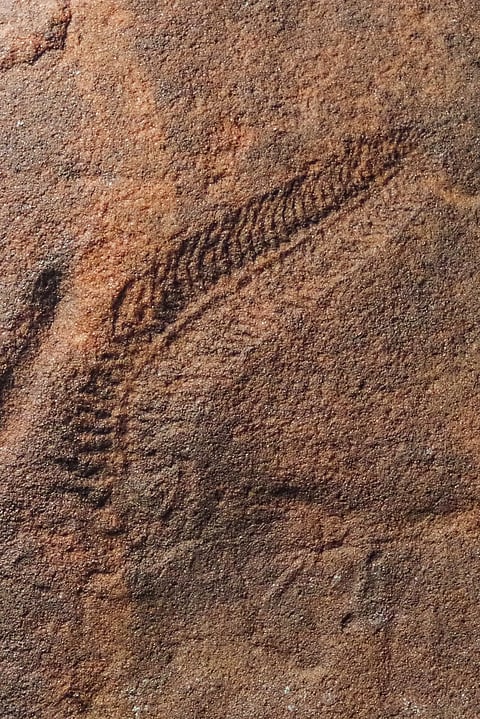
In a study published in Scientific Reports, palaeontologists analysed fossils of Spriggina, a thumb-sized, worm-like organism that crawled the ancient seafloor 550 million years ago during the Ediacaran period.
They discovered that these creature impressions consistently curved to the right, representing the earliest known evidence of behavioural lateralisation, or "handedness," in the animal kingdom.
As soon as you get something that has a left and a right side, as Spriggina does, you start to see evidence of it preferring one side over the other, notes Scott D Evans, a palaeontologist at the American Museum of Natural History and the study's lead author.
Handedness is ubiquitous in nature. It appears in DNA's right-twisting double helix, human tooth-scratch patterns dating back 1.8 million years, and even the fossilised escape scars found predominantly on the right flanks of ancient trilobites. From an evolutionary standpoint, picking a side offers a distinct survival advantage. When escaping a predator or navigating obstacles, an animal saves critical split-seconds if it does not have to pause and decide which direction to turn or which appendage to move first.
To uncover this, researchers utilised 3D laser scans to analyse more than 100 Spriggina specimens excavated from Nilpena Ediacara National Park. The organism — which features a segmented body and a head resembling a medieval helmet — left behind impressions showing how it wriggled across ancient microbial mats.
The 3D data revealed a stark biological bias: roughly twice as many fossils showed Spriggina bending to the right as those curving to the left. The curves indicate that Spriggina was highly active, likely crawling by contracting its body like a modern flatworm or nudibranch.
While ocean currents could theoretically skew fossil alignment, independent palaeontologists doubt this was the case here. If strong currents were responsible, the specimens would be swept uniformly in a single direction rather than bent in various, distinct right-curving postures.
Instead, this physical bias points to surprisingly advanced sensory and motor capabilities for such an early organism. Ultimately, Spriggina's rightward bias links this ancient lifeform directly to modern species, including us. Specialising one side of the body is a really beneficial part of this body plan, Evans notes. Spriggina has a front, a back, a left, and a right side — the same basic blueprint that we all share today.
The New York Times
