
- Chennai
- Tamil Nadu
- India
- World
- EntertainmentEntertainment
- Business
- Sports
- Lifestyle
- Technology
- Videos
- Explainers
- Editor's Picks
Cathy Wilcock
The massive popular revolution that swept Sudan in 2019 has since been eclipsed by the devastating civil war between the Sudanese Armed Forces and the Rapid Support Forces. However, the events of 2019 demand closer academic and political attention, as they hold vital lessons for the eventual rebuilding of a post-war Sudanese society.
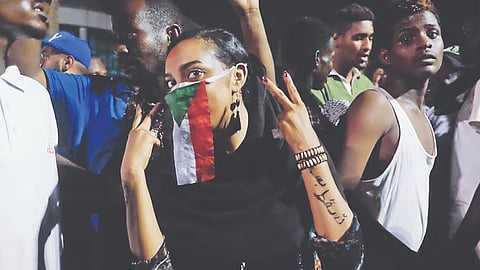
Central to those historic protests was music. The massive sit-in camp outside the military headquarters in Khartoum, where demonstrators gathered for weeks to demand civilian rule, effectively transformed into the largest arts festival in Sudan’s history. Recent research based on interviews with protesters and musicians reveals that music was far from a cosmetic accessory to the movement. Instead, it was an integral engine of the revolution that ousted the Omar al-Bashir regime, cultivating decades of anti-government sentiment and forging the resilient social networks that sustained the 2019 uprising.
Music in Sudan has long been intertwined with popular resistance, first against British colonial rulers and later against post-colonial military despots. The patriotic anthems of the 1960s and 1970s famously established the cultural sentiment that Sudan was built by its ordinary citizens, not its autocrats. In response, consecutive authoritarian regimes sought to crush creative expression through strict censorship laws and the systematic intimidation of artists. Public concerts were forced underground, re-emerging as private gigs in domestic spaces that were still regularly raided by the state’s morality monitoring units.
This oppressive environment drove an exodus of musicians, producers, and fans. Yet, this displacement did not weaken popular resistance. Instead, it built powerful transnational networks. Sudanese musicians recorded anti-government tracks abroad and distributed them back to communities inside the country. Decades of state restrictions failed to silence these creative spaces, allowing the music scene to consistently imagine alternatives to authoritarian rule and build the deep relationships necessary for collective action.
An analysis of the most prominent revolution songs chosen by protesters reveals a growing societal openness toward shifting dynamics of gender and class. At the 2019 protests, revolutionaries honoured a diverse canon of anti-oppression anthems that bridged traditional Sudanese staples, contemporary hip-hop, and pop sing-alongs.
Crucially, not all of these revolutionary anthems were lyrically political. Under Sudan’s patriarchal autocracy, speaking openly about politics through song lyrics carried a much higher risk for women than for men. Consequently, women-led genres like tumtum and aghani albanat typically centred on romance and daily life, driven by handclapping and rhythms played on the traditional doolka drum. Elite cultural critics historically dismissed these percussive, vocal genres as artistically inferior to male-dominated genres like haqeeba, which featured complex instrumentation on the oud.
Yet, during the 2019 revolution, these women-led genres became immensely popular. Their power did not lie in political lyrics, but in the sheer defiance of the women who created them despite decades of institutional suppression. By celebrating these joyful, feminine rhythms, the revolution sent a powerful message about cultural openness and a collective desire to dismantle state-enforced patriarchal hierarchies.
Similarly, the revolution elevated Zenig, a newer genre that emerged in the early 2010s from the impoverished peripheral neighbourhoods of Khartoum. Mixing the fast-paced rhythmic base of tumtum with low-fi synths, cheap keyboards, and improvised vocals, Zenig was a distinctly urban, working-class invention that deliberately defied conservative class structures.
Prior to the revolution, Zenig was stigmatised as the music of poor outcasts. At the 2019 sit-in, however, its rapid tempo energised the crowds, echoing from small stages and intimate circles where young people danced together. The inclusion of Zenig proved that the revolution was not merely about replacing a political regime; it was an expression of a deep yearning to upend deep-seated societal power relations.
The 2019 revolution provided a unique, fleeting window for democratic experimentation and future-making facilitated by song. While the current war has tragically halted these vital social negotiations—displacing musicians to hubs like Cairo and Nairobi, and costing many their lives—the underlying cultural resistance remains. Even as Sudan’s immediate future remains profoundly uncertain, music will undoubtedly return to the centre of civilian life when the time comes to rebuild.
