
- Chennai
- Tamil Nadu
- India
- World
- EntertainmentEntertainment
- Business
- Sports
- Lifestyle
- Technology
- Videos
- Explainers
- Editor's Picks
Jake Brooker & Zanna Clay
During an eight-month research trip to the Democratic Republic of Congo and Zambia, we studied consolation: how bonobos and chimpanzees comfort each other after conflicts. Early on, however, we noticed something unexpected.
The animals were exchanging friendly physical contact — embracing, touching and kissing — in competitive situations before any clear conflict or distress broke out. We began to wonder what all that touching was actually for.
Our new research suggests this behaviour dates back at least six million years, long before our species evolved. Like us, our closest ape cousins navigate stressful, competitive situations daily.
For instance, when they discover a tree laden with ripe fruit, everyone wants to eat, and competing interests can spark fights. Yet, more often, apes reach out to one another with friendly gestures, embracing, patting and making gentle contact.
Our colleague, Dutch biologist Edwin van Leeuwen, developed a feeding task called the "peanut swing" to measure social tolerance across great ape groups. A bamboo trough filled with peanuts is swung over a fence, spreading the food evenly across a small area while researchers record who gets food and how much. We used this test to measure whether groups could share resources peacefully in close proximity.
Because the apes watched the trough being loaded, we could observe their behaviour as anticipation built. Friendly touch clustered in the minutes just before the food arrived. Earlier researchers called this celebration, but discovering food is not just a cause to celebrate. It is also tense and risky.
Could friendly physical contact help keep that tension at bay?
To find out, we measured a five-minute anticipation period before releasing the food. We recorded everything the apes did, including friendly contact like kissing, embracing and patting, alongside aggression and threats. Over several months, we filmed 116 apes from five groups across 60 sessions at two African sanctuaries: Lola ya Bonobo in the DRC and Chimfunshi in Zambia.
In both species, the answer was clear. Bonobos and chimpanzees that engaged in more reassuring friendly contact before the food arrived spent significantly more time feeding peacefully alongside others afterwards. This pattern held across most groups and was strongest in the most tolerant ones. Researchers consider tolerance — the willingness to share space without aggression — to be the foundation of cooperation and social learning. Our findings suggest that pre-emptive friendly touch helps maintain that tolerance.
These patterns aligned with the social structure of each species. In bonobos, female-female pairs showed friendly reassurance most often, reflecting how females form strong alliances to counter male aggression. In chimpanzees, males reassured each other most, reflecting the importance of male coalitions.
However, in groups with more authoritarian leaders, this pattern vanished.
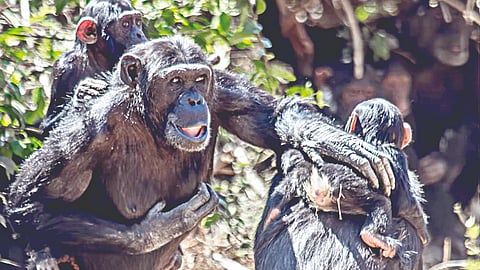
Some of the most striking behaviour occurred among chimpanzees. During tense moments, they placed fingers, hands and other body parts inside each other's mouths, or held each other's genitals. For a species known for lethal aggression, these are extraordinarily risky acts.
Perhaps that vulnerability is itself the signal of trust: you only offer a risky contact if you are confident the other animal will not bite.
