
- Chennai
- Tamil Nadu
- India
- World
- EntertainmentEntertainment
- Business
- Sports
- Lifestyle
- Technology
- Videos
- Explainers
- Editor's Picks
Danielle Friedman
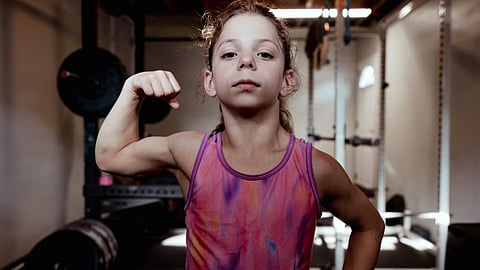
Lucy Milgrim rubbed chalk on her palms and positioned her pink and blue high-tops on the gym floor. She bent her knees, pushed her hips back and took a few deep breaths. Then, when her father said go, she braced and dead-lifted a 145-pound barbell.
Lucy is 10 years old and weighs 58 pounds.
“My fingers can finally touch!” she said, as her grip wrapped around the bar.
I joined Lucy and her parents, Michelle and Brett Milgrim, in their garage gym on New York’s Long Island, to watch one of Lucy’s strength training workouts. Lucy, who is in fourth grade, complemented her lifting with pullups and ring dips. In between sets, she talked about her favourite hairstyle (battle braids) and told stories about classmates who challenged her to lift them up at recess.
Lucy started strength training when she was 8, and she holds three US records in powerlifting. She is a champion wrestler, too.
She is also the star of Instagram and TikTok accounts run by her parents, which together have 232,000 followers. An Instagram video in which she dead-lifted 180 pounds at a powerlifting meet, a personal record, has been viewed more than 67 million times and has 3.7 million likes.
She said she became interested in powerlifting after watching her parents work out. She asked her father, a lawyer and a wrestling coach, to train her.
He has never had to push her to train or to attempt heavier lifts, he said. “Lucy just has always naturally been the type of kid that, when she says I’m going to do something, you better step aside,” he said.
Lucy is one of a small but growing crop of kid fitness influencers attracting big followings on social media. Parents of these elementary schoolers and even toddlers share videos of their children hoisting barbells, pushing weighted sleds, doing dead hangs and otherwise flexing their muscles.
The fact that these accounts have attracted large followings reflects both a recent rise in strength training among young people and the reality that it’s still not yet mainstream, said Heather Faas, executive director of USA Powerlifting. When people see “a kid lifting weights, and with good technique and form, it’s pretty mind-blowing,” she said.
Until 20 years ago, authorities advised children not to lift heavy weights. This was largely because of a misconception that it could stunt their development by damaging growth plates, the weakest part of a bone, said Dr Andrew Peterson, a professor of paediatrics and orthopaedics at the University of Iowa.
But research has shown that strength training can be both safe and beneficial for children, as long as they are old enough to follow directions and are closely supervised by a coach or trainer to guide them on proper form, technique and progression.
A 2020 report from the American Academy of Pediatrics recommended resistance training for children and adolescents not only to improve their health and fitness but also to prevent and recover from injuries. “We’ve known it’s safe for quite some time now, but there were still some old-school coaches that were a little resistant,” said Peterson, who was a co-author of the 2020 report.
The New York Times
