
- Chennai
- Tamil Nadu
- India
- World
- EntertainmentEntertainment
- Business
- Sports
- Lifestyle
- Technology
- Videos
- Explainers
- Editor's Picks
Indian politics has long been defined by a stubborn regionalism. In states like Assam, Kerala, Punjab, Tamil Nadu, and West Bengal, distinct linguistic identities, social-reform movements, and deep-seated secular or pluralist traditions sustained for decades what analysts called a “fortress of federalism,” insulated from the ideological reach of the “Delhi Sultanate” (the central government). But the results of five state elections this month suggest that the fortress has been breached.
Perhaps the most dramatic shift occurred in West Bengal. For 15 years, Mamata Banerjee and her Trinamool Congress were viewed as the definitive bulwark against the Hindu-nationalist (Hindutva) centralization of the BJP. The TMC’s brand of “Subaltern Secularism,” rooted in Bengali cultural pride, successfully repelled the BJP as recently as the last elections, in 2021.
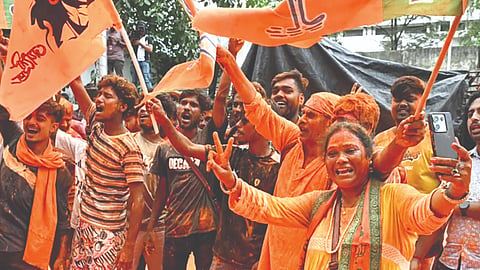
During the April–May 2026 election campaign, however, the BJP managed to bridge the gap between Hindutva and Bengali identity. By focusing on the RG Kar case—the brutal rape and murder of a young doctor, which sparked statewide protests over women’s safety—and highlighting systemic corruption and high-handedness in the TMC, the BJP upended the TMC’s claim to be the voice of the Bengali people. The results speak for themselves: the BJP won a staggering 207 of 294 seats in the West Bengal Legislative Assembly.
To be sure, questions linger about the Election Commission’s Special Intensive Revision of the state’s electoral rolls. The review was supposed to remove duplicate, migrated, or deceased voters, but 3.4 million of the nine million who were struck off the rolls appealed the decision—and 2.7 million appeals were still pending when the election took place, meaning that those voters were barred from participating.
Since the BJP won by just over three million votes, the opposition has cried foul. But analysts point out that the number of deleted votes exceeded the BJP’s margin of victory in only 46 constituencies, suggesting that the party would have carried the state anyway.
The implications of the BJP’s victory extend beyond West Bengal. By defeating the TMC, the BJP has removed a vocal opponent of its national agenda, especially initiatives seemingly designed to put Muslims on the defensive, such as the Uniform Civil Code. More fundamentally, it has proven that even the most formidable regional identity can be politically subdued if it is tethered to an unpopular incumbent.
In Tamil Nadu, it was a movie star who rewrote the script. For over 50 years, the state has been locked in a bipolar struggle between two Dravidian parties: the DMK and AIADMK. This year, the former actor C Joseph Vijay and his fledgling party, TVK, shattered that arrangement.
Instead of running on the traditional Dravidian platform of Tamil ethnic and linguistic chauvinism, the charismatic Vijay leveraged popular disillusionment with the veteran political class, together with his celebrity, to win over young people. Gen Z, Vijay recognised, is looking for disruptors capable of bypassing party hierarchies.
Organised in hundreds of fan clubs and mobilised by campaign events that felt more like movie premieres than political rallies, young voters embraced the promise of a “post-Dravidian” future that emphasises efficiency, digital transparency, and global competitiveness over old-school ideological purity. With 108 of 234 legislative assembly seats, the TVK is now Tamil Nadu’s largest party.
Kerala, the other southern state to hold elections, has historically been the ultimate sanctuary of the Indian Left. In 1957, it became the first state in the world to elect a communist government democratically. Beginning in 1977, power alternated in every election between the LDF, led by the CPM, and the UDF, led by the Congress.
In 2021, the LDF broke that pattern by winning a second consecutive term. But this year, the party’s “Kerala Model” finally hit a wall. With the LDF plagued by a massive Rs 4.5 lakh crore public debt and an aging leadership that failed to connect with a mobile, globalised workforce, the UDF triumphed overwhelmingly this time around, securing 102 of 140 legislative-assembly seats and ending the LDF’s decade-long rule.
The results gave a boost to Congress, proving that it can still win decisive mandates when it focuses on local governance. For the LDF—and especially the CPM—they amount to an existential crisis. Following the defeat of Chief Minister Pinarayi Vijayan, the party is not in power anywhere in India for the first time in nearly a half-century. Though it is too early to write off the CPM, without a state to govern, it risks being reduced to a pressure group or a historic relic, rather than a viable political force.
To be sure, not every Indian state election brought change this month.
In Assam, the status quo was defended aggressively. Linking economic development with a hardline stance on demographics, Chief Minister Himanta Biswa Sarma of the BJP-led NDA targeted illegal immigrants from Bangladesh (“infiltrators”) and positioned himself as the protector of indigenous Hindus and Assamese. The strategy worked: Sarma led the BJP to its strongest-ever performance in Assam, winning 82 of the legislative assembly’s 126 seats.
The Assam result proves that ethnic anxiety and religious identity remain a potent electoral cocktail, capable of breathing new life into a ten-year incumbency. With Sarma having emerged as the BJP’s most powerful regional satrap, the party appears likely to replicate his identity-first governance in other border states, especially where anxious populations might be receptive to the BJP’s high-pitched Islamophobia.
Underpinning these results is a sharpening of India’s religious and social fault lines. The BJP’s focus in recent years on religious identity, together with its “purification” of voter rolls, has created a more binary and potentially volatile political landscape, where election results increasingly reflect ethno-religious identity.
The May elections arguably deepened the Hindu-Muslim political divide. Whereas Hindu voters were often attracted by the BJP’s warnings of demographic and cultural threats, Muslim voters increasingly abandoned smaller regional or faith-based parties to consolidate behind Congress and other major national opposition forces. In Assam, 18 of the 19 victorious Congress candidates are Muslim.
As the old regional bulwarks crumble, we will either see the continued consolidation of BJP dominance or the reshaping and renewal of the opposition. The next set of assembly elections early next year—in Goa, Manipur, Punjab, Uttarakhand, and Uttar Pradesh—will indicate which scenario is more likely.
(Shashi Tharoor, a former UN under-secretary-general and former MoS for External Affairs and MoS for Human Resource Development, is a member of the Congress.)
Project Syndicate
