
- Chennai
- Tamil Nadu
- India
- World
- EntertainmentEntertainment
- Business
- Sports
- Lifestyle
- Technology
- Videos
- Explainers
David E Sanger & William J Broad
President Donald Trump went to war with Iran partly to enforce two long-standing US demands: Tehran must halt nuclear fuel enrichment for at least two decades and allow international inspectors unrestricted access.
On Wednesday, Trump took the opposite approach with Saudi Arabia, a key regional ally. To secure a deal for Westinghouse and other US firms to build two nuclear reactors on Saudi soil with more planned Washington opened the door for Riyadh to enrich its own fuel after just two years.
The US also yielded to Saudi demands to opt out of an inspection framework followed by over 140 nations, which Riyadh claimed was overly intrusive.
Now, Trump must convince Congress and Middle Eastern allies that diluting nuclear standards for a close partner will not trigger wider proliferation in an already volatile region. If daily missile strikes with Tehran yield to fresh talks, Iran will almost certainly cite these Saudi concessions to demand equal treatment.
Administration officials insisted on Wednesday there was no cause for concern, claiming heavy US involvement in Saudi Arabia’s nuclear programme would prevent any diversion of fuel or technology towards a covert bomb project.
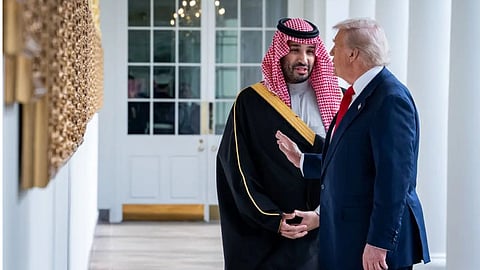
Trump has many reasons to solidify the American relationship with Saudi Arabia these days. He can argue that if the US does not provide the country with its best reactors and nuclear technology, Russia or China will. At a time when tensions have flared with the Saudis for a while Crown Prince Mohammed bin Salman prohibited the US from launching attacks on Iran from US bases in Saudi Arabia anything that draws the Saudis deeper into the US technology stack makes sense to the White House.
“Rest assured, these agreements uphold the highest standards of nuclear safety and nonproliferation,” Energy Secretary Chris Wright said in a statement Wednesday announcing the deal, “while relying on the world’s best nuclear technology and scientists, designed right here in the US.”
Wright signed the deal with the Saudi minister of energy, Prince Abdulaziz bin Salman, but the White House did not immediately release the text or the two secret letters accompanying it. All of those will now go to Capitol Hill for congressional review. But as a practical matter, Congress would have to assemble a veto-proof majority to override Trump’s initiative.
It is a process that has been used many times under the Atomic Energy Act of 1954, a key element of Dwight D Eisenhower’s “Atoms for Peace” programme. The idea was to spread nuclear energy, with safeguards to assure that fuel is not diverted to bomb projects.
But Saudi Arabia poses a particular kind of problem, hard to imagine in Eisenhower’s time. It is a country racing to shed its petroleum-based past and eager to embrace nuclear energy to build data centres and power a future driven by artificial intelligence, yet fearful of what might happen if the Iranians get the bomb.
Saudi officials have made no secret of their determination to keep pace with Iran’s apparent efforts to build a nuclear weapon, and to match them if they do. In 2018, Crown Prince Mohammed pledged that his kingdom would try to develop or acquire nuclear weapons if Iran continued its work toward a bomb despite the fact that Saudi Arabia signed on to the Nuclear Nonproliferation Treaty in 1988, after delaying for 18 years. Other Saudi officials have issued similar warnings in recent years, or talked about the need for Saudi Arabia to become a “threshold” nuclear state, a few screwdriver turns away from building its own weapon.
“I find this decision incredibly shortsighted,” said James M Acton, a nuclear analyst at the Carnegie Endowment for International Peace. “You cannot exclude the possibility that Saudi Arabia would nationalise this facility and use it to make a bomb.”
It is hardly a new problem. President George W Bush negotiated a similar deal with the UAE, finalised by President Barack Obama in 2009, whose terms were so restrictive that it became known as the gold standard of nuclear agreements. The UAE now has four civilian nuclear reactors, built largely with the help of South Korea, and there is little worry that the country is interested in anything other than electricity production.
When South Korea went down the same path, the US won a 10-year moratorium on its making its own fuel. But when President Lee Jae-myung came to Washington late last year, he got an agreement from Trump to lift the restraints.
“It was clear Saudi Arabia was going to be different than the Emiratis,” said Robert Einhorn, a nuclear expert at the Brookings Institution who negotiated many of the toughest nuclear agreements of the past few decades as a State Department official. “They felt the inspections were just too intrusive and they weren’t going to renounce enrichment forever.”
Once the terms of the Saudi deal are made public, other nations may well insist on the same treatment. The UAE has a proviso in its accord that allows it to demand “consultations” with the US if a neighbouring country gets a better deal.
To those who worry that the world is on the cusp of a new nuclear breakout what John F Kennedy warned about just before his assassination the Saudi deal is a step toward that danger. Kennedy was wrong when he predicted there would be more than two dozen nuclear-armed nations by the 1970s. Today, there are nine, but it may turn out he only got the timing wrong.
