
- Chennai
- Tamil Nadu
- India
- World
- EntertainmentEntertainment
- Business
- Sports
- Lifestyle
- Technology
- Videos
- Explainers
- Editor's Picks
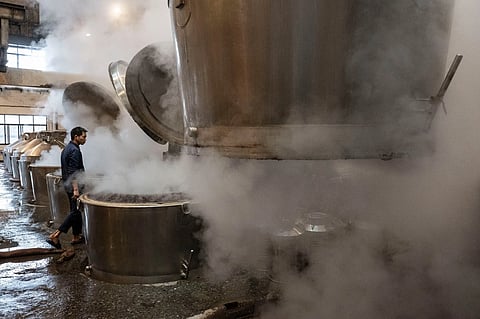
The gigantic factory stretches for more than a mile along the riverbank, belching steam laced with the aroma of China’s “national drink” — a gullet-searing grain spirit that, according to local lore, helped propel Mao Zedong to power, smoothed Richard Nixon’s 1972 visit to Beijing and turned a remote mountain valley into “the liquor capital of China.”
But, drenched for decades in the fumes and profits of its booze business, the town of Maotai in China’s southern Guizhou province is now nursing a bad hangover.
A nationwide ban on drinking alcohol at official banquets, an economic slowdown that has cut expense account boozing and the more health-conscious habits of a young generation with little appetite for 100-plus-proof alcohol have dented the fortunes of the state-controlled Kweichow Moutai, the town’s biggest employer with more than 30,000 workers, and hundreds of smaller, private distilleries scattered throughout the mountains.
All produce much the same product: a highly potent colourless drink made from sorghum and known as “baijiu.” The most famous brand is Moutai, a name derived from an archaic English transcription of Maotai, the Chinese name for the riverside town where it is made.
Once a sleepy, one-factory backwater, Maotai has had an expensive makeover aimed at attracting Chinese tourists and buyers for local booze. Its central district is filled with ersatz traditional wooden buildings stuffed with baijiu stores and baijiu-themed restaurants.
Behind the state-controlled distillery, however, most of the hundreds of shops selling different brands of baijiu along a long shopping street are empty. Anxious sales staff, desperate for business, shout at passersby, offering free tastings and discounts on purchases of baijiu ladled from large earthenware vats.
An acquired taste, the baijiu from Maotai, prized for its “sauce aroma,” tastes like grain alcohol blended with soy sauce and leaves its malodorous smell on the drinker’s breath for hours or even days.
“Under no, repeat no, circumstance should the president actually drink from his glass in response to banquet toasts” of baijiu, Nixon was advised before his arrival in Beijing by his deputy national security adviser, Alexander Haig. (He ignored the warning.)
Unlike many other Chinese products, from electric cars to stuffed toys, baijiu has struggled to break into foreign markers and relies almost entirely on domestic sales. For a time, these were so strong that Kweichow Moutai’s share price skyrocketed to make it China’s most valuable company, ahead of tech giants like Alibaba and Tencent.
Over the past five years the company has lost more than a third of its market value. It also lost three managing directors to Communist Party corruption investigations and two more to management shake-ups forced by disappointing results.
Flying Fairy, the company’s flagship product, sold for more than $500 a bottle before China’s biggest property developer collapsed in late 2021 and set off a long slump in real estate prices. Known as “liquid gold,” it served for years as a stable alternative currency widely used to bribe officials.
A bottle now sells for around $200.
That is still expensive — far more than what it costs to produce — and a surge in demand for alcohol before Chinese New Year festivities braked an accelerating decline of Moutai’s price.
China first put a damper on the “baijiu” business in 2012, when President Xi Jinping, newly installed as the country’s top leader, restricted drinking at military functions as part of a campaign to curb graft and drink-fueled indiscipline. Drinking baijiu fell further out of favour in 2016 after several officials in the central province of Anhui died from alcohol poisoning following boozy banquets.
Starting last May, all alcohol, including Moutai, previously an indispensable feature of official and business banquets across China, has been banned at all government events.
“One drink can make you lose your position,” state media warned.
A large red slogan atop the entrance to Kweichow Moutai’s huge distillery sends a somewhat different message: “Love our Moutai. Win glory for the country.” The company, which is still highly profitable but unaccustomed to communicating with the world outside its fortresslike premises, did not respond to interview requests.
Hardest hit by the downturn, however, are the small, privately owned distilleries, whose bottles of grain spirit never fetched the astronomical prices commanded by the state-controlled giant.
The New York Times
