
- Chennai
- Tamil Nadu
- India
- World
- EntertainmentEntertainment
- Business
- Sports
- Lifestyle
- Technology
- Videos
- Explainers
- Editor's Picks
Michelle Goldberg
Elon Musk is still mad about 'The Odyssey'.
For months, he and his acolytes have been throwing an online tantrum about the casting of Christopher Nolan’s version of the ancient epic, particularly his choice to have Black actress Lupita Nyong’o play Helen of Troy and transgender actor Elliot Page play the warrior Sinon. Now that the film is out, some conservatives have acknowledged that there’s nothing particularly woke about Nolan’s blockbuster tale of masculine honour and sacrifice. It takes liberties with the source material, as any Hollywood version would, but one of its chief departures is a moral framework that’s more Christian than pagan, which shouldn’t offend most social conservatives.
Nevertheless, Musk has been stewing. On Tuesday, he promised to make a “historically accurate” artificial intelligence-generated ‘Odyssey’ movie by year’s end, posting an absurdly kitschy clip made by his Grok image generator. In doing so, he inadvertently highlighted one reason Nolan’s ‘The Odyssey’ is so powerful — because it represents a revolt of the human in a world overstuffed with AI slop.
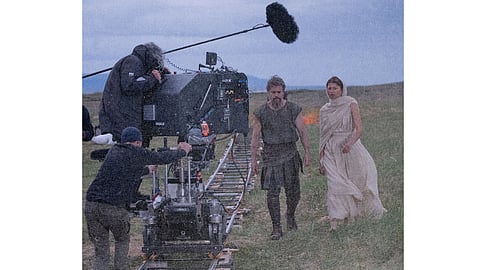
Despite its sprawling canvas, Nolan’s ‘The Odyssey’ is often strikingly intimate in scale and sparing in its use of computer-generated effects. “We like to spend a lot of time in real places, on real locations, having stuff in front of the camera that is tangible and tactile,” his cinematographer Hoyte van Hoytema told The New York Times. The Cyclops Polyphemus wasn’t an AI creation, but a 60-foot animatronic puppet. The Sirens are small figures in the distance, Hades a murky field. In The Telegraph, Robbie Collin described Nolan filming aboard a wooden ship amid a real-life storm, with extras clutching the sides and vomiting, creating the movie’s sense of tempestuousness. Nolan knows how to build hyper-real fantasy realms, as he did in ‘Inception’ and ‘Tenet’, but in ‘The Odyssey’, he’s opted for the earthy over the glossy and grandiose.
Some of the polarising narrative choices Nolan has made seem downstream of this approach. The film does not create a lavish ancient dream world for viewers to get lost in. The gods are barely present, except for a subdued Athena played by Zendaya. “Nolan’s ‘Odyssey,’ unlike Homer’s, is a story completely disenchanted, devoid of the supernatural, aside from like the odd witch or two that shows up,” complained right-wing influencer Matt Walsh, who compares the movie unfavourably to ‘Gladiator’, ‘The Lord of the Rings’ and Mel Gibson’s ‘Apocalypto’. The film’s stakes feel more psychological than mythic.
That seems to be exactly what viewers are responding to, turning ‘The Odyssey’ not just into a hit but a cultural phenomenon, with some people travelling by plane for the chance to see it in IMAX 70 millimetre. (As The New York Post reported, Manhattan’s only theatre to show the film in that format is sold out for every screening through Aug. 19.) There might seem to be a contradiction between its absence of eye candy and its success as a spectacle. But AI has rendered eye candy cheap. Viewers long for the visceral.
Movie theatres are experiencing a resurgence, with 2026 on track to be the best year for ticket sales since 2019, defying earlier predictions that streaming would cause the industry's downfall. While box office sales previously declined following the pandemic, a strong, younger audience demographic is driving this comeback, with Gen Z now identified as the most active moviegoers, according to a Fandango study.
What’s striking, though, isn’t just that people are returning to theatres; it’s the sort of films they’re going to. Recent movies that look artificial — including ‘Supergirl’, the live-action ‘Moana’ and ‘Star Wars: The Mandalorian and Grogu’ — have flopped. By contrast, the low-budget horror movies ‘Obsession’ and ‘Backrooms’, which rely on frightening premises rather than otherworldly imagery, have been enormous hits.
Nolan celebrates youth’s rejection of AI. “After years of driving toward heavily virtual environments, we’re seeing a renewed interest in more tactile, more real forms of storytelling,” he says.
It is this ethos, more than multiracial casting, that makes ‘The Odyssey’ a rebuke to Musk’s ideology, with its video game-derived visions of grandeur and conviction that algorithms can make art. He’s probably right to hate it. He’s wrong that his machines could ever conjure anything close.
The New York Times
