
- Chennai
- Tamil Nadu
- India
- World
- EntertainmentEntertainment
- Business
- Sports
- Lifestyle
- Technology
- Videos
- Explainers
- Editor's Picks
GUILHERME CASARÕES
Three weeks ago, Brazilian President Luiz Inácio Lula da Silva’s political obituaries had all been written. The far-right presidential candidate, Flávio Bolsonaro, son of the jailed former President Jair Bolsonaro, had come out of the first round of the presidential election with a lead that looked impossible to overcome.
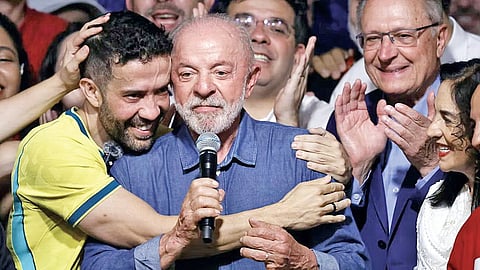
At 80 years old, Lula seemed headed for a quiet exit after four decades at the centre of Brazilian political life. On Sunday, however, Lula proved everyone wrong. He won the runoff and secured a fourth non-consecutive term as Brazil’s president.
The election result is unprecedented in Brazilian politics in at least three ways. First, no Brazilian presidential candidate had ever won the first round and then lost the runoff.
Second, no Brazilian president has ever been elected to four terms. When his new term ends, Lula will have governed Brazil for 16 (non-consecutive) years – the longest democratically elected tenure in the country’s history. Third, no runoff campaign in Brazil has ever brought so many people to the streets and onto social media, supporting both sides. Unlike the first round, the second round was not quiet, nor was it decided by television ads. Brazil saw a mass mobilisation of voters, and it was ferocious.
The Brazilian left fought an uphill battle against social media platforms, economic elites, and a Supreme Electoral Court whose president was accused of trying to tip the balance to favour Bolsonaro. Lula has a long record of political miracles, and he has added another one to the list.
Lula’s victory matters well beyond Brazil’s borders, also in three ways. Globally, Brazil remains a bulwark against the rise of the far right. In recent elections across Latin America and Europe, far-right parties and leaders have advanced almost everywhere. Brazil, the world’s fourth-largest democracy, has now bucked the trend, and is a symbol that democrats elsewhere will not ignore.
Regionally, Lula has defied the so-called “incumbent curse”. Over the past decade in Latin America, governing parties have lost election after election, punished by voters for inflation, insecurity and economic stagnation. Brazil’s economy was in reasonable shape, but its gains were modest and unevenly felt. Everything pointed to a defeat, and Lula beat the odds anyway. His win is also a check on what critics have called the “Donroe Doctrine”, referring to the Trump administration’s push to bring the Western Hemisphere more firmly into the US sphere of influence through tariffs, threats and political patronage.
Bolsonaro had campaigned as Washington’s preferred partner in South America. Brazil’s voters turned that offer down.
Domestically, the result also shows the power of popular mobilisation on the left. After Lula’s poor first-round showing, Lula’s campaign re-energised demoralised supporters and built a broad coalition of voters, some of whom were voting less for Lula than against what Bolsonaro represents. It also mobilised people who had stayed home in the first round to get out to vote.
Lula should not mistake survival for vindication. Yes, he corrected course. In three weeks, he acknowledged the mistakes he made over four years in office, especially during a lacklustre first-round campaign. He sharpened his message, widened his alliances and spoke directly to the voters he had lost. That is no small achievement for a politician, however experienced he may be.
But he now has to govern a country more polarised than ever. Political violence on the streets has increased, and hate speech circulates freely online.
Prominent figures on the far right have already said they will not accept this election result. Bolsonaro said late Sunday he will not concede, and will seek an annulment of the vote.
And then there is Washington. Given the White House’s close ties to the Bolsonaro family, there is a real risk the Trump administration will question, or even refuse to recognise, the outcome of the election. That would be extraordinary, and a few years ago, it would have been unthinkable.
Things are further complicated by a legal battle on election day itself. Whatever the legal merits, the dispute gives the losing side a ready-made narrative of “voting irregularities”. This could be a matter of serious concern, and it may last for weeks.
When Lula is inaugurated on January 5, three questions will define his fourth term.
The first is how Lula will govern a deeply divided country with a conservative majority in Congress and over a dozen right-wing state governors. Every budget, every reform and every appointment will be a tough negotiation, with the possibility of an impeachment hanging over Lula’s head.
The second is repair. How will he deal with problems that go well beyond partisan disputes? These include fiscal pressures from rising government spending, a steady loss of trust in democratic institutions, and an institutional system that no longer works as designed.
The Supreme Court, once the guarantor of the democratic order, has seen its legitimacy eroded by a major financial scandal surrounding Banco Master. Although the president cannot “repair” a court, he can refuse to treat the crisis as someone else’s problem.
The third question is the most important. Will Lula, his Workers’ Party (PT) and Brazil’s broader democratic forces use this reprieve to renew Brazilian politics? That would mean: new political leadership alternatives beyond the ageing leaders who have dominated the left for 40 years; new forms of popular political participation that do not depend on a single charismatic figure; a new narrative that speaks to the precarious workers, religious families and angry voters who have drifted toward the far right. This is the only real antidote to polarisation, and it will not come from a single election or a single leader. Lula has worked another miracle. His last task is to make sure Brazil does not need another one.
