
- Chennai
- Tamil Nadu
- India
- World
- EntertainmentEntertainment
- Business
- Sports
- Lifestyle
- Technology
- Videos
- Explainers
- Editor's Picks
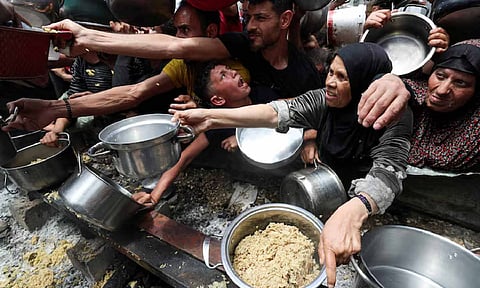
GAZA: After 18 months of punishing airstrikes, raids and an increasingly restrictive siege in Gaza, the United Nations on May 20, 2025, issued one of its most urgent warnings yet about the ongoing humanitarian crisis: an estimated 14,000 babies were at risk of death without an immediate influx of substantial aid, especially food.
The assessment came a day after Israel allowed the first trickle of aid back into Gaza following its nearly three-month total blockade imposed on March 2. But on the first day of that resumption, the U.N. Office for the Coordination of Humanitarian Affairs reported that only nine trucks were allowed into Gaza, when around 500 are required every day. The U.N. called it “a drop in the ocean of what is urgently needed.”
As an expert in Palestinian public health, I and others have long warned about the potentially devastating humanitarian consequences of Israel’s military response to the Hamas attacks of Oct. 7, 2023, given the preexisting fragility of the Gaza Strip and Israel’s history of controlling humanitarian aid into the territory. Many of those worst-case humanitarian predictions have now become reality.
Israel’s control of food and aid into Gaza has been a consistent theme throughout the past 18 months. Indeed, just two weeks after Israel’s massive military campaign in the Gaza Strip began in late 2023, Oxfam International reported that only around 2% of the usual amount of food was being delivered to residents in the territory and warned against “using starvation as a weapon of war.”
Yet aid delivery continues to be inconsistent and well below what was necessary for the population, culminating in a dire warning by U.N. experts in early May that “the annihilation of the Palestinian population in Gaza” was possible without an immediate end to the violence.
Already, an estimated near 53,000 Palestinians have died and some 120,000 have been injured in the conflict. Starvation could claim many more. Amid the broader destruction to lives and infrastructure, there is now barely a food system to speak of in Gaza. Since October 2023, Israeli bombs have destroyed homes, bakeries, food production factories and grocery stores, making it harder for people in Gaza to offset the impact of the reduced imports of food.
But as much as things have worsened in the past 18 months, food insecurity in Gaza and the mechanisms that enable it did not start with Israel’s response to the Oct. 7 attack by Hamas. A U.N. report from 2022 found that 65% of people in Gaza were food insecure, defined as lacking regular access to enough safe and nutritious food.
Multiple factors contributed to this preexisting food insecurity, not least the blockade of Gaza imposed by Israel and enabled by Egypt since 2007. All items entering the Gaza Strip, including food, became subject to Israeli inspection, delay or denial.
Basic foodstuff was allowed, but because of delays at the border, it could spoil before it entered Gaza.
A 2009 investigation by Israeli newspaper Ha’aretz found that foods as varied as cherries, kiwi, almonds, pomegranates and chocolate were prohibited entirely.
At certain points, the blockade, which Israel claimed was an unavoidable security measure, has been loosened to allow import of more foods. In 2010, for example, Israel started to permit potato chips, fruit juices, Coca-Cola and cookies.
By placing restrictions on food imports, Israel has claimed to be trying to put pressure on Hamas by making life difficult for the people in Gaza. “The idea is to put the Palestinians on a diet, but not to make them die of hunger,” said one Israeli government adviser in 2006.
To enable this, the Israeli government commissioned a 2008 study to work out exactly how many calories
Palestinians would need to avoid malnutrition. The report was released to the public only following a 2012 legal battle. Echoes of this sentiment can be seen in the Israeli decision in May 2025 to allow only “the basic amount of food” to reach Gaza to purportedly ensure “no starvation crisis develops.”
The long-running blockade also increased food insecurity by preventing meaningful development of an economy in Gaza. The implications for Palestinians in Gaza have never been more dire.
Already, the WHO estimates that 57 children have died from malnutrition just since the beginning of the March 2, 2025, blockade. More death is certain to follow. On May 12, the Integrated Food Security Phase Classification, a global system created to track food insecurity, released an alarming report on projections of food insecurity in Gaza. It warned that by September 2025, half a million people in Gaza – 1 in 5 of the population – will be facing starvation and that the entire population will experience acute food insecurity at crisis level, or worse.
