
- Chennai
- Election-2026Election-2026
- Tamil Nadu
- National
- World
- Cinema
- Business
- Sports
- Lifestyle
- Technology
- Videos
- Explainers
The first warning sign might be quiet moves by Beijing to move financial assets away from Western countries that might freeze them in a war. A second might be patriotic campaigns in China calling on citizens to donate blood.
Then, amid troop movements and debates about whether these constituted a genuine threat or were a bluff, cyberattacks might disable a chunk of Taiwan’s electrical grid and banking system, and the island’s internet service would grow sluggish because of sabotage of undersea cables linking Taiwan to the world.
Missiles would strike the presidential office and military and intelligence sites in an attempted decapitation, and perhaps also American bases in Japan and Guam to keep US forces from riding to the rescue. Chinese ships would blockade Taiwan, with a special focus on keeping the US and Japan from providing assistance.
That’s an extreme version of what an initial Chinese attack to take over Taiwan might look like, drawn from conversations with military planners and from a forthcoming book, “Defending Taiwan,” by Eyck Freymann of Stanford University.
Pentagon strategists worry about such invasion scenarios, for that’s their job. But Taiwanese officials are (rightly, I think) more focused on “gray zone” moves on Taiwan that fall short of war. An all-out invasion of Taiwan by China might well fail, but gray zone pressures today pose a daily challenge and are likely to grow. And they, too, risk escalation into all-out war that pulls in the United States.
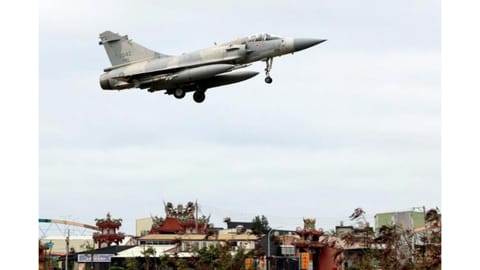
In this gray zone, China is mounting cyberattacks, cutting internet cables and sending planes and ships toward Taiwan. It also holds live-fire military exercises, most recently a couple of weeks ago, to try to bully the island into accepting a future as some kind of autonomous zone under China’s oversight. One metric of the gray zone: In 2025, China undertook an average of 2.6 million cyberintrusions per day against Taiwan’s infrastructure, according to a new Taiwan government report.
If President Xi Jinping of China wanted to dial up the pressure and wear down Taiwan further without necessarily starting a war, he could impose a naval quarantine. Even if some ships did not obey the quarantine, the move would raise insurance and shipping costs and undermine Taiwan’s economy.
The next step up from a quarantine would be a blockade, particularly of oil and gas, and that would probably lead to all-out war. Taiwan’s economy depends on imported petroleum products, and it has only two or three weeks’ worth of natural gas on hand. Taiwan’s future might then depend on whether President Trump were willing to order the US Navy to escort ships to Taiwan to break the blockade.
If China succeeded in absorbing Taiwan, whether through war or peacefully through gray zone pressure and salami slicing tactics, the result would be the collapse of the first island chain that limits China’s capacity to project power in the Pacific. China might also gain the highly advanced chip fabs of the Taiwan Semiconductor Manufacturing Co. — in strategic terms, the most important corporation in the world. If the fabs were disabled by war, the result would be “a global economic depression,” the Council on Foreign Relations concluded in a 2023 report.
That’s why deterrence is essential, and the US, Taiwan and US allies such as Japan and the Philippines have a reasonable chance of deterring a serious Chinese military action if they work together.
But here’s the central puzzle of Taiwan: While the rest of the world frets about the risk of war in the strait, many Taiwanese don’t seem to. During the recent Chinese military exercises around Taiwan, for example, Taiwan’s stock index rose.
President Lai Ching-te, whom China despises, seems to appreciate the risks and has tried to increase military spending and boost military readiness. But it’s not clear whether the Taiwanese people want to be led in that direction, and his proposed supplementary military budget may not even pass the legislature.
Given the stakes, a top priority for US foreign policy must be deterring China without provoking China. Deterrence means working with Taiwan, Japan and others to achieve a common front not just against an invasion but against gray zone pressures. If deterrence failed and a war actually erupted, then it obviously would be better to win than to lose, but this might be a case where, as President John F. Kennedy once put it, “even the fruits of victory would be ashes in our mouth.”
The New York Times