
- Chennai
- Tamil Nadu
- India
- World
- EntertainmentEntertainment
- Business
- Sports
- Lifestyle
- Technology
- Videos
- Explainers
- Editor's Picks
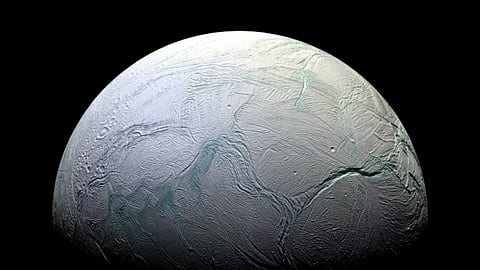
A small, icy moon of Saturn called Enceladus is one of the prime targets in the search for life elsewhere in the solar system. A new study strengthens the case for Enceladus being a potentially habitable world.
The data for these findings comes from the Cassini spacecraft, which orbited Saturn from 2004 to 2017. In 2005, Cassini discovered geyser-like plumes of water vapour and ice grains erupting continuously from cracks in Enceladus’ icy shell.
In the latest study, Nozair Khawaja of the Free University of Berlin and his colleagues re-analysed a Cassini sample collected near Enceladus’ south pole. Most earlier analyses focused on material deposited in Saturn’s E-ring, which is replenished by Enceladus’ plumes. That material, however, is not fresh, and prolonged exposure to radiation can alter its chemical characteristics.
Khawaja’s team instead examined younger material sampled during a fast Cassini flyby through the south polar plumes. Using freshly ejected particles reduced the risk of radiation interference and made the samples more representative of their source.
Earlier Cassini data revealed sodium salts in plume material, suggesting the plumes originate from a liquid water ocean beneath the ice and in contact with a rocky seabed. Later measurements of Enceladus’ slight rotational “wobble” showed that its icy shell is likely detached from the rocky core. This implies that the ocean is global, extending beneath the entire surface.
The ocean is thought to be sustained by tidal flexing. As Enceladus orbits Saturn, changing gravitational forces stretch and squeeze the moon, generating internal heat that prevents the ocean from freezing solid.
Indirect sampling of this ocean through plume material has allowed scientists to assess Enceladus’ habitability — whether it contains the chemical ingredients and energy sources required for life as we know it.
Cassini analysed plume particles using mass spectrometry. At high speeds, impacts between the spacecraft and solid particles broke the material into charged fragments. These fragments were steered by an electric field toward a detector, and their arrival times were used to determine their mass and charge, allowing scientists to identify the original molecules.
Organic molecules, which contain carbon, are especially important because life on Earth is carbon-based. Such organics have been confidently detected in Enceladus’ plumes, including amines, which can be precursors to amino acids.
Carbon is part of the “CHNOPS” group — carbon, hydrogen, nitrogen, oxygen, phosphorus and sulphur — that makes up most living matter on Earth. All but sulphur have been detected in plume material.
Photosynthesis is unlikely in Enceladus’ ocean, which lies beneath kilometres of ice and is almost certainly dark. But life need not rely on sunlight. On Earth, chemosynthetic ecosystems thrive around hydrothermal vents on the ocean floor, where microbes extract energy from chemical reactions.
The ingredients needed for similar chemosynthetic processes, including carbon dioxide and hydrogen, appear to be present in Enceladus’ ocean. The amount of hydrogen detected in the plumes is so large that it likely requires an ongoing source, most plausibly hydrothermal activity on the seafloor.
By analysing freshly ejected plume material, the new study reduces uncertainty caused by radiation and plume formation. The samples revealed new substances and confirmed others, reinforcing the conclusion that they originated within Enceladus and pointing again toward hydrothermal processes.
With Enceladus’ potential habitability increasingly clear, the European Space Agency is planning a mission in the 2040s to conduct close flybys and possibly orbit or land on the moon. Equipped with more advanced instruments, it will search plume material for evidence of life — evidence that, if life exists within Enceladus, may already be drifting through space.
The Conversation
