
- Chennai
- Tamil Nadu
- India
- World
- EntertainmentEntertainment
- Business
- Sports
- Lifestyle
- Technology
- Videos
- Explainers
- Editor's Picks
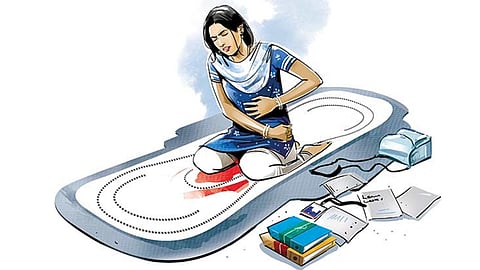
When the Governor of Kerala, while addressing the first day of the Kerala Assembly, read out the policy statement of the new Congress government, he announced a three-day holiday for school girls during their menstrual period with a promise of substitute classes during the weekend to make up for the loss. He also announced free travel in public sector buses for women. While the latter announcement enhances the mobility of women, the former demobilises them.
Perhaps the year 2026 could be called the year the courts became concerned about menstrual hygiene. At the beginning of this year, the Supreme Court ruled that menstrual hygiene is a basic right of women, referable to Article 21, and directed all state governments to supply sanitary pads to school girls free of cost. The power to issue such a direction was traced to the Right to Free Education Act (Dr Jaya Thakur v. Government of India).
Following this, no state government other than Kerala has announced menstrual leave for school girls (for three days). It is not clear whether any detailed discussions were held by the government with stakeholders in girls' education. The new Congress government, immediately on assuming power, made such a policy declaration without broader consideration. In fact, out of 10 months of an academic year, the loss of 30 days due to menstrual leave can never be compensated, and it is a thoughtless move, as leave should be an option, not a compulsion. What is required is imparting menstrual hygiene and providing appropriate materials to maintain it. Educationists have regularly been demanding the installation of vending machines for the distribution of sanitary pads and a proper disposal mechanism in schools.
It was only a few weeks ago that the Supreme Court rejected a Public Interest Litigation seeking menstrual leave for women workers, and the Chief Justice of India dismissed the plea. The judges, however, said that introducing such a policy would not benefit women; instead, it would harm them by reinforcing gender stereotypes and affecting their employability. They said this could make private-sector employers hesitant to hire women and might ultimately discourage their recruitment. They also observed, "Nobody will give them responsibilities, even in judicial services, a normal trial will not be assigned to them." (Shailendra Mani Tripathi v. Secretary, Ministry of Women and Child Development)
The idea of suggesting menstrual leave for women workers came up when the Madras High Court struck down Section 66A of the Factories Act, 1948, rendering the ban on night shifts invalid. In the course of the judgment, the Madras High Court made several recommendations, including:
“Apart from the facilities, which are permissible under the Factories Act, an additional holiday shall be permitted for the women workers during their menstruation period, which shall be a paid holiday for the night shifts.” (Vasantha R, 2001)
Despite such sympathies expressed, no employer has come forward to grant such leave in the last two decades. At the same time, the courts came down heavily on prejudices against women on the notions of impurity and pollution associated with menstruation and called it a symbol of exclusion. In the Sabarimala case, the Supreme Court also brought such exclusion under Article 17 prohibiting untouchability and held:
“The social exclusion of women, based on menstrual status, is but a form of untouchability which is an anathema to constitutional values. As an expression of the anti-exclusion principle, Article 17 cannot be read to exclude women against whom social exclusion of the worst kind has been practised and legitimised on notions of purity and pollution.” (Indian Young Lawyers Association, 2019)
However, this ruling, given seven years ago, is now sought to be reviewed by a nine-judge bench, and its decision is expected immediately after the summer recess of the Supreme Court.
Menstruation is a new fad that everybody has started discussing, except the women employees themselves. In fact, Justice Nagarathna made a pertinent remark when hearing the case of a woman munsif terminated on the grounds that her work was not up to the mark, following a serious gynaecological surgery and a miscarriage. When the case came for admission, she said, “If men menstruated, they would understand”.
In a similar way, when people now suggest that women should have more children without any restrictions, little do they realise the importance of taking their options, and physical and mental health, into account before demands are raised. When Dr Ambedkar, as part of the government exercise in the late 1940s, was suggesting methods for family planning, there was opposition within the government. He wrote:
“If men had to bear the pangs which women have to undergo during childbirth, none of them would ever consent to bear more than a single child in their lives”
The issue of menstrual leave should be left in the hands of women planners. It is high time the government implements the 106th constitutional amendment and allows Parliament and State assemblies to have one-third women membership to enable them to take such sweeping decisions.
K Thulasi is Advocate, High Court of Madras
