
- Chennai
- Tamil Nadu
- India
- World
- EntertainmentEntertainment
- Business
- Sports
- Lifestyle
- Technology
- Videos
- Explainers
- Editor's Picks
David Lees
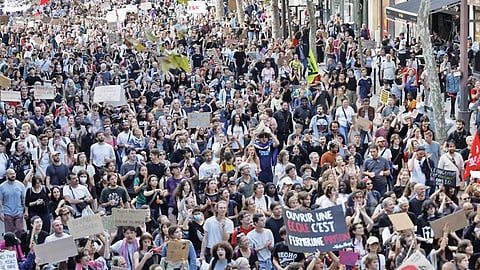
The student demonstrations that have spread across France in recent weeks are not unprecedented. Indeed, commentators have been quick to draw comparisons with the events of May and June 1968, when, at their peak, more than 10 million students and workers took to the streets.
In 1968, as now, there were legitimate reasons for protest. The unrest began at the Nanterre campus of the University of Paris, which was miles from the city centre and poorly equipped for the changing social norms of the 1960s. In particular, the ban on women and men entering each other’s accommodation was the catalyst for initial demonstrations that then spread to central Paris and beyond.
Today’s parallels with the past are unmistakable. What began in September as a demonstration at the poor quality of high school (lycée) buildings in the Parisian suburbs (this time Saint-Denis) has escalated into wider protests about the conditions facing young people in France today.
In addition to the disproportionate number of missed days of teaching in underprivileged areas, students have been complaining about the appalling insulation of school buildings and the complexity of the post-school training and education application platform.
In 1968, the regime of General Charles de Gaulle came under severe pressure. De Gaulle was so convinced that he would lose control of the situation that he travelled to Germany to meet representatives of the French Army, who would be prepared to “invade” France to protect the general if required.
Despite the best efforts of de Gaulle’s prime minister, Georges Pompidou, police actions against the students, and later the millions of striking workers, were brutal. Now – as then – the police across France have also been accused of heavy-handedness, including firing tear gas directly at protesters. The use of stun grenades has been banned, after a 15-year-old reportedly lost a hand after picking one up at a protest.
Sébastian Lecornu, France’s beleaguered prime minister, has stated that he believes the students and young people have genuine concerns, while also defending the police response.
Revolt and rebellion are nothing new in France. There is a strong history of taking to the streets to protest, dating back to the revolution of 1789 via various revolutions and rebellions – in 1830, 1848, 1871 and 1944, along with many others.
No president of the current Fifth Republic has avoided some form of protest during their time in office. But what makes this wave of demonstrations so interesting is the way that political actors have sought to capitalise on events.
In May and June 1968, the Parti Communiste Français (the French Communist Party) condemned the students as bourgeois and was slow to realise the potential of the demonstrations. By contrast, Jean-Luc Mélenchon of La France Insoumise (LFI), also on the far-left, has been quick to respond.
This nostalgia for protests of the past is serving the far left rather than the political centre. Indeed, Emmanuel Macron, already the least popular president of the current Fifth Republic, is hamstrung by the political stalemate in the National Assembly caused by his disastrous decision to call elections in June-July 2024.
Those associated with Macroncentre, especially the two candidates most likely to represent the moderate branch of French politics, Gabriel Attal and Édouard Philippe, seem not to have caught the mood of the protests. Having both served as prime ministers under Macron, they are seen by protesters to be complicit in the declining standards in French schools.
Nostalgia is not limited to the far-left, though. The protests come at a time when the far-right Rassemblement National party and its presidential candidate, Marine Le Pen, continue to question accepted versions of France’s past. Le Pen has her own appeal to youth through a protectionist economic approach. It looks to limit the power of the European Union in shaping the French economy and has always challenged the notion that the French state was responsible for atrocities during the Algerian War of Independence and the Second World War.
It remains to be seen whether Macron and his government can do enough to address the concerns of youth in the coming weeks. If not, he and his Renaissance party – and the rest of the moderate centre – may well lose the debate when France goes to the polls in April and May 2027.
