
- Chennai
- Tamil Nadu
- India
- World
- EntertainmentEntertainment
- Business
- Sports
- Lifestyle
- Technology
- Videos
- Explainers
- Editor's Picks
Mark Williams, Lorenzo Lustri, Tom Harvey & Yu Liu
The publicity posters for the 1955 cult horror movie Tarantula! featured a giant arachnid rampaging across the desert, clutching a human victim in its viciously long fangs. The film perfectly captured our collective dread of spiders — their creepy, multi-legged motion and the terrifying way they stab prey to inject lethal venom.
Spiders and scorpions are some of nature’s most accomplished hunters. Now, our new research into remarkable fossils excavated from Yunnan, southern China, is revealing the earliest origins of those fearsome fangs.
Spiders, scorpions, mites, ticks, horseshoe crabs, and sea spiders all belong to a diverse group called chelicerates. This group is a branch of the arthropods — animals defined by their jointed limbs and external skeletons (the distinct crunch you hear if you accidentally step on one).
What unites chelicerates is a pair of specialised front limbs called chelicerae. These appendages are modified into pincers or fangs used for grasping, tearing, or stabbing prey. If you have ever been bitten by a tick, it was its saw-like chelicerae that drew blood and locked into your skin.
Today, chelicerates are incredibly successful, boasting well over 100,000 species. While fossil evidence shows their ancestors have been hunting on land for more than 400 million years, their deepest roots actually lie in the ancient oceans of the Cambrian period, over 500 million years ago. This was an era of rapid evolutionary experimentation that shaped the future of animal life.
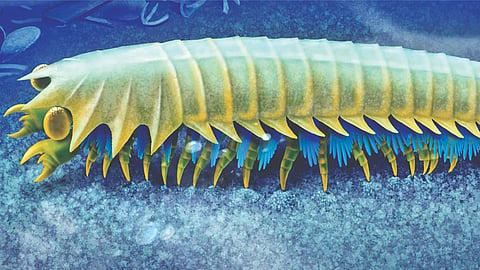
One of these Cambrian sea creatures is Urokodia, named after its Greek-derived "shielded tail." It thrived in the tropical seas covering southern China about 518 million years ago.
At first glance, Urokodia does not look like a spider relative. Measuring just two to three centimetres long, it possessed large, stalked eyes and an elongated, shrimp-like body supported by jointed underside limbs. However, when we used advanced X-ray imaging to peer closer at its head, we discovered two pincer-like limbs emerging right next to its eyes. These are an ancient, primitive form of chelicerae.
Furthermore, some of Urokodia’s other legs bore finely layered, page-like structures. These were likely gills used for underwater breathing, strikingly similar to the "book gills" found on modern aquatic chelicerates like horseshoe crabs.
Urokodia represents a vital link in the evolutionary chain. It connects modern arachnids to other crucial Cambrian fossils, such as Megachelicerax — a "big-clawed" predator that swam in the ancient seas of North America a few million years later.
These fossils also hint at ties to even more ferocious Cambrian hunters, including the half-meter-long Anomalocaris, one of Earth’s very first apex predators. Anomalocaris used formidable frontal limbs to seize prey and a circular, plate-lined mouth to tear them apart.
In the delicate anatomy of Urokodia, we see the blueprint for the specialised limbs that would one day evolve into spiders' deadly fangs. It marks the humble beginning of a lineage that produced some of the planet's most formidable predators — though, thankfully, none quite as massive as the monster in Tarantula!
