
- Chennai
- Tamil Nadu
- India
- World
- EntertainmentEntertainment
- Business
- Sports
- Lifestyle
- Technology
- Videos
- Explainers
- Editor's Picks
In certain corners of the internet recently, people have been debating why “women can’t stop reading fairy porn”.
The discussions centre around the fantasy romance genre, also known as romantasy, which has exploded in both popularity and sales.
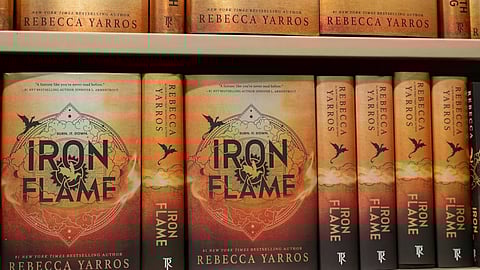
Onyx Storm, Rebecca Yarros’s third book in The Empyrean series, was the fastest-selling adult novel in 20 years when published in early 2025, according to the New York Times, selling more than 2.7 million copies in its first week. Bloomberg estimated that romantasy brought in $610m in sales in 2024, revitalising the publishing industry.
Traditionally, male readers have dominated fantasy fiction fandoms, and narratives centring women have often been sidelined. Think of JRR Tolkien’s Bilbo and Frodo Baggins or Fitz from Robin Hobb’s The Farseer Trilogy.
Romantasy counters this trend, offering fantasy worlds where romance is a key plot point. The protagonists are often women, and the stories centre women’s lives and romantic relationships.
Female characters embark on “hero journeys”, meet handsome and caring men, experience romance and sexual pleasure, and defeat evil. Romantasy follows familiar fantasy tropes – good versus evil, medieval settings, magical schools and fantastical creatures – while incorporating romance tropes such as enemies to lovers, forbidden love and forced proximity.
The genre is often dismissed as erotica or “smut” for women. While readers sometimes rank books by “spice” levels, sexual content is not new to fantasy.
Popular series like George RR Martin’s A Song of Ice and Fire include frequent and graphic sex scenes. What distinguishes romantasy is its focus on consensual sex and female-centred sexual pleasure, alongside complex themes. Yarros’s Fourth Wing, for instance, explores chronic illness, while Sarah J Maas’s A Court of Thorns and Roses addresses trauma, grooming, war and poverty.
Romantasy authors, who are often women, aim to eschew the “male gaze”, a concept described by feminist film scholar Laura Mulvey in which women are presented as passive objects for male pleasure. In contrast, romantasy centres a “female gaze”, exploring desire, power and identity from women’s perspectives.
In our study, women said romantasy allows them to experience romantic and sexual fantasies they may not access in real life, and helps them discover and experiment with their sexuality. Younger readers found liberation in non-taboo depictions of women’s desires, while women from conservative cultures were inspired by female characters unashamed to seek pleasure.
The genre is not without issues. Some popular books perpetuate heterosexual norms, ignore racial and sexual diversity, or offer limiting representations. Rebecca Yarros, for example, states that Xaden in Fourth Wing is not white without specifying his race, as though all non-white identities are interchangeable. Yet even when women cannot fully relate to the protagonists, many resonate with stories that prioritise female pleasure and safety, and partners devoted to them.
While sex is important to romantasy, it is not erotica. “Spicy” scenes are usually brief and embedded within a broader romantic arc. As the genre grows, we hope it is taken seriously by publishers and the public. Beyond TikTok-driven, repetitive stories, diverse examples already exist, from Legends and Lattes by Travis Baldree to works by NK Jemisin and Shannon Chakraborty. Perhaps in time, romantasy will support and promote stories that appeal to all kinds of women.
The Conversation
