
- Chennai
- Tamil Nadu
- India
- World
- EntertainmentEntertainment
- Business
- Sports
- Lifestyle
- Technology
- Videos
- Explainers
- Editor's Picks
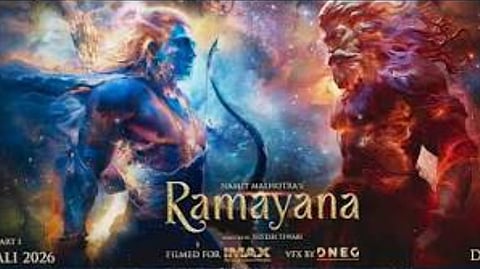
American audiences will be able to watch an English-dubbed version of director Nitesh Tiwari’s upcoming Hindi film Ramayana in theatres next month.
The Sanskrit Ramayana, or Journey of Rama, is an epic poem composed between 400 BCE and 400 CE. The epic follows Rama, an exiled prince and incarnation of Vishnu, as he journeys to rescue his wife, Sita, from the demon king Ravana.
For centuries, people from different religious traditions across South Asia have retold the Ramayana through dramas, narrative poems, shadow puppet plays, pageants, folk songs, comics, television shows, etc. Tiwari’s upcoming film represents the latest cinematic retelling of this vast epic tradition.
For over a decade, I have studied how South Asian epics have been retold within and outside the Indian subcontinent. While many American moviegoers may not recognise the word “Ramayana,” they may have already encountered its characters and stories on the big screen.
A striking example is Academy Award-winning director Alfonso Cuarón’s 1995 film, “A Little Princess.” Although an adaptation of Frances Hodgson Burnett’s well-known 1905 children’s novel of the same name, Cuarón’s movie begins with Sara Crewe – the daughter of a wealthy British Army captain posted in colonial India – telling the story of the Ramayana.
As Sara narrates the tale of Rama, the film presents scenes inspired by the epic. Actors portraying Rama and Sita are shown living in exile in a lush green forest. When Sita begs Rama to follow a demon disguised as a beautiful golden deer, Rama draws a magical protective circle around the princess and instructs her to stay within the circle’s borders. The story reaches a turning point with the demon king Ravana’s abduction of Sita after she exits the circle.
But the Ramayana is more than a story to Sara – it has parallels with her own life, especially after she is separated from her father when she moves to New York to attend boarding school. Cinema and media studies scholar Jyotsna Kapur explains that “the man cast as Rama is Sara’s father and the Ramayana is the imaginative thread that binds father and daughter together through their struggles while apart.”
At boarding school, Sara initially lives like a princess – like Sita – thanks to her father’s immense fortune. Yet after the apparent death of Captain Crewe in World War I, Sara’s headmistress confines the now-penniless child in the school’s attic.
While mourning her father, the heartbroken Sara uses a piece of chalk to draw a circle on the floor of the attic resembling the one Rama creates to protect Sita. Like Sita, Sara is eventually rescued – by Captain Crewe, who survives the war, and they return home to India.
By weaving these stories together, Cuarón used the epic’s themes of exile and separation to provide a fresh take on Hodgson Burnett’s classic novel.
The divine monkey Hanuman is one of the most beloved Ramayana characters. In the epic tradition, Hanuman is a loyal devotee of Rama, and he is the one who locates where Sita is being held captive in Ravana’s kingdom of Lanka.
Hanuman shows up in multiple different films. Pixar animator Sanjay Patel’s Academy Award-nominated 2015 short film, Sanjay’s Super Team, focuses on Sanjay, an Indian American boy who would rather watch cartoons than worship Hindu deities like Hanuman, Vishnu and the goddess Durga with his father.
Sanjay, however, gains a new appreciation for his family’s religious traditions when he reimagines Hanuman, Vishnu and Durga as superheroes resembling the three protagonists of his favourite animated television show, Super Team.
Ryan Coogler’s massively popular Marvel movies Black Panther and Black Panther: Wakanda Forever are set in the fictional African country of Wakanda. In both films, a character called M’Baku proclaims “Glory to Hanuman!” M’Baku is the leader of the Jabari tribe, a Wakandan community that worships a gigantic white gorilla deity.
In the original Black Panther comics, this gorilla god is known as Ghekre and is based on a deity of the same name revered by the Akan Baoule people of the Ivory Coast. But in the Black Panther movies, the Jabari’s gorilla god is referred to as Hanuman.
Hanuman is at the heart of Dev Patel’s 2024 critically acclaimed action-thriller Monkey Man. The unnamed hero of this movie is an Adivasi belonging to one of India’s many indigenous groups. Hanuman inspires him to avenge the rape of his mother by a corrupt policeman working for a deceitful Hindu nationalist spiritual leader.
My book examines cinematic adaptations of both the Ramayana and the Mahabharata, the South Asian epic about a catastrophic war. Monkey Man draws from a variety of distinct narratives, including the Ramayana tradition and popular modern American revenge films like John Wick, to shed light on key social issues in contemporary India.
Interpretations of the Ramayana also surface in Danny Boyle’s 2008 Oscar winner for Best Picture, Slumdog Millionaire. The film follows Jamal Malik, an impoverished contestant on the Indian version of Who Wants to Be a Millionaire?. When asked, “In depictions of God Rama, he is famously holding what in his right hand?”, Jamal experiences a vivid flashback to the 1992 Mumbai riots that followed the demolition of the Babri Masjid.
As a five-year-old child fleeing the mob that killed his mother, Jamal encounters a boy dressed as Rama holding a bow and arrow. The adult Jamal subsequently states: “I wake up every morning wishing I didn’t know the answer to that question. If it weren’t for Rama and Allah, I’d still have a mother.”
The newest Ramayana movie’s tagline, “Our Truth, Our History,” suggests a single, definitive way to tell the story. Yet as indicated by Hollywood films like A Little Princess, Slumdog Millionaire, Sanjay’s Super Team, Black Panther and Monkey Man, there is no single way to depict or understand this immensely diverse epic tradition.
Sohini Sarah Pillai is Assistant Professor of Religion at Kalamazoo College
