
- Chennai
- Tamil Nadu
- India
- World
- EntertainmentEntertainment
- Business
- Sports
- Lifestyle
- Technology
- Videos
- Explainers
- Editor's Picks
Even a mild fever signals stress in the human body. Small changes in the Earth's climate system can be just as telling, and just as disruptive. Atmospheric carbon dioxide (CO₂) concentrations have reached 427 parts per million, while the Earth's average temperature continues to rise above historical levels.
Every year at the UNFCCC Conference of the Parties (COP), nations that are parties to the Paris Agreement meet to assess efforts to combat climate change. The COP31 meeting began in Turkiye on November 9 and will run until November 20. Similarly, countries that are parties to the United Nations Convention on Biological Diversity (CBD) meet separately to address biodiversity loss. For the first time, COP31 is positioning biodiversity protection as an essential pillar of climate mitigation and adaptation. This unified approach comes at a critical juncture: science increasingly demonstrates that ecosystems such as oceans and forests are not just passive victims of climate change but also part of the solution.
The global population has grown from one billion in 1804 to more than eight billion today, driving demand for food, energy, transportation, housing and industrial development. While development has improved living standards through better housing, transportation, energy, healthcare and economic opportunities, it has also placed greater pressure on natural resources and ecosystems. The challenge is not whether development should continue, but how to make it more sustainable through innovation, efficiency, circularity, and responsible resource management.
The Planetary Health Check 2026 warns that the Earth system may be approaching critical tipping points, where gradual pressures can trigger sudden and potentially irreversible changes. Scientists have identified nine Planetary Boundaries that regulate Earth's stability, seven of which have already been breached. As these pressures interact and intensify, they increase the risks of floods, droughts, heatwaves, storms and other disruptions to both human societies and natural ecosystems.
At COP31 in Turkiye, the "Blue Frontier" agenda brings greater attention to the conservation of marine and coastal ecosystems. This complements the objectives of the recently ratified High Seas Treaty (BBNJ Agreement) and gives India an important opportunity to showcase its rich coastal and marine heritage while advancing Nature-based Solutions (NbS) for climate resilience and sustainable development.
Climate action should not be viewed solely through the lens of emissions reductions. Equally important is the democratisation of sustainable technology. Just as open-source software has revolutionised access to digital tools, open-source environmental technologies, indigenous knowledge systems, and frugal innovations can help address challenges in pollution control, clean water, sanitation, energy access, and sustainable livelihoods. By documenting, improving, and scaling these solutions, society can make sustainability more accessible and inclusive. Emerging research suggests that climate responsibility may vary significantly within countries as well as between them, highlighting the need for more nuanced approaches to climate equity.
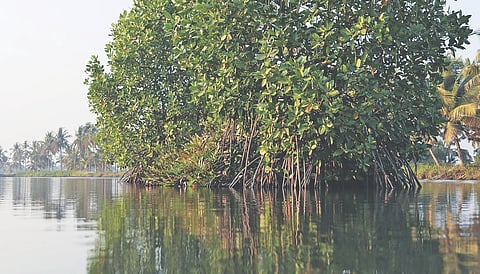
India's 11,098-km coastline, blessed with a tropical climate, harbours a complete spectrum of marine and coastal ecosystems — from mangroves and vibrant coral reefs to seagrass meadows, seaweed beds, dunes, estuaries, and salt marshes. Among these, mangroves can store up to four times more carbon than many terrestrial forests by capturing carbon in both their trees and the carbon-rich soils beneath them, while also serving as a natural shield that protects coastal communities from storms, erosion, tsunamis, and sea-level rise. The immediate challenge is sustaining these coastal and marine ecosystems while ensuring that their economic and ecological contributions are adequately incorporated into climate policy and adaptation planning.
Even in the case of coastal and marine ecosystems, the way we measure value may be too narrow. Their direct contribution to GDP may appear modest when viewed solely through a business or accounting lens, yet this fails to capture the immense benefits they provide through food security, livelihoods, carbon storage, biodiversity conservation, coastal protection, and disaster risk reduction.
To address this gap, ocean accounting is emerging as an important approach that brings together statisticians, economists, and scientists to quantify the value of natural capital and ecosystem services. Such efforts can help ensure that the true economic, social, and environmental contributions of oceans and coasts are reflected in policy and investment decisions.
A mangrove forest, for example, may contribute little to GDP compared with a port or an industrial facility, yet its value in protecting lives and infrastructure from cyclones, storm surges, erosion, and sea-level rise can be immense. More needs to be done to change the way we assess economic value so that natural capital and ecosystem services are adequately recognised in policy and investment decisions.
Addressing these challenges requires the collection of diverse and high-quality data across environmental, social, and economic domains, combined with modern computing tools, artificial intelligence, and advanced analytics to support objective and evidence-based decision-making. Significant progress has been made in Earth observation, environmental monitoring, and modelling.
However, globally and nationally, our sensing capabilities and reliable, affordable sensors for data collection are still evolving, and important gaps remain in understanding complex interactions within the Earth system. As a result, some future projections inevitably carry uncertainties, a point that is increasingly being questioned and debated by younger generations seeking greater transparency and clarity.
Climate change, biodiversity loss, ocean health, pollution, and resource sustainability do not recognise national boundaries. They are global issues that require international cooperation, shared data, open access to knowledge and technology, and collective action. While solutions must fit local conditions, the overall effort needs to be driven by a global movement that combines scientific evidence, technological innovation, capacity development and societal participation. Bridging the gap between scientific understanding and practical action will be critical in the years ahead.
Nature has sustained life on Earth for billions of years by following three simple principles: drawing energy from the Sun, using biodiversity to provide food and maintain ecosystem balance, and ensuring that waste from one process becomes a valuable resource for another. These principles offer important lessons for building a more sustainable future.
Humanity faces intertwined challenges of development, biodiversity, oceans, technology, equity, and sustainability, and the solutions require rethinking how we value nature. Beyond negotiations, COPs are becoming powerful platforms for global cooperation, helping unite efforts to protect our climate, oceans and biodiversity for future generations.
Venkatesan is a former consultant at UNESCO; Senior Fulbright Fellow; Adjunct Professor, University of Massachusetts Dartmouth, USA
