
- Chennai
- Tamil Nadu
- India
- World
- EntertainmentEntertainment
- Business
- Sports
- Lifestyle
- Technology
- Videos
- Explainers
- Editor's Picks
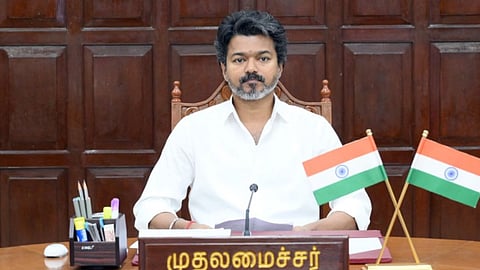
Since becoming the chief minister of Tamil Nadu on May 10, C Joseph Vijay has addressed zero press conferences. No newspaper, television channel, or digital platform has been given an interview, nor has a journalist gotten close enough to lob a question at him. This follows the pattern of his successful election campaign, during which he had no on-air interactions with the media. His reaction to the Karur stampede last September was issued in the form of a pre-recorded video statement, spoken to the camera. His campaign rallies made no room for media enclosures, even.
It is clear that this is going to be Vijay’s media plan during his term as chief minister. It is not to be taken as an expression of contempt for the media but rather as a carefully crafted strategy to conserve his charisma and to ensure that his message to the people is not subjected to any refraction through the media. As minister KA Sengottaiyan implied last month, it is not a chief minister’s job to provide “routine political commentary”; it is to convey the nuance of governance to the people, which, he deems, is best done directly.
However, while a direct-to-people media strategy, executed through public addresses and social media posts, has its utility and is a politician’s right to use as suits him or her, it does fall short on two counts: feedback and accountability. A leader speaking from the lectern can tune his pitch to perfection, but cannot hear the murmurs in the audience. A press conference, on the other hand, serves the purpose of bringing feedback to the leader and, by posing adversarial questions, gives him or her the opportunity to be accountable and open to being challenged, which is the trait of a confident leader.
Globally, the new brand of leaders emerging into politics today has two opposite styles to choose from. At one pole, all by himself, is Donald Trump, who breaks all conventions and makes himself available to even rookie reporters on the telephone or through impromptu “press gaggles” in his office. This allows him to dominate the discourse as no other leader has ever been able to. At the other pole is Narendra Modi, who makes himself precious to the media by holding no press conferences at all and speaking to people only through public addresses. While he too sets the agenda, he succeeds in doing so only by following a punishing schedule of public appearances and by exercising any number of devices from the authoritarian toolkit.
Vijay’s communication strategy seems to be patterned after Modi, without, however, having the luxury of being able to control the messaging through instruments of state. The aim seems to be to prolong his mystique and preserve brand quality. That sort of thinking comes to us from the world of films, the chief minister’s former metier, where the thing to be sold is a product, a movie, with a short shelf life. There, A-list stars are preserved from overexposure by a back-office staff and then brought to peak at the right time by a phalanx of stylists and media whisperers. In politics, and especially in power, that degree of image control is impossible to sustain and difficult to protect from the unforeseen. Image control in public office is an ever-evolving game. Trying to predefine it comes with attendant risks, such as appearing evasive or becoming frozen as a flexi.
