
- Chennai
- Election-2026Election-2026
- Tamil Nadu
- National
- World
- Cinema
- Business
- Sports
- Lifestyle
- Technology
- Videos
- Explainers
At a time when the West is resorting to colonialism again Gaza, Greenland, Venezuela, Iran it’s heartening to hear that a British museum has returned a sacred idol stolen from Tamil Nadu, just one of thousands appropriated during the Raj or robbed and hawked to art markets in the West since Independence.
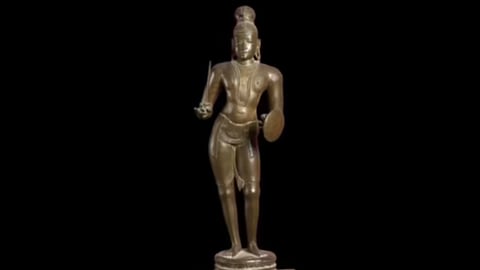
The 16th century bronze idol of Thirumankai Alvar, the last of the 12 Alvar saints, was stolen from the Soundararaja Perumal temple in Thadikombu in 1967. It made its way into a private collection and thence to the University of Oxford’s Ashmolean Museum by way of a Sotheby’s auction. After it was bought “in good faith” by the museum, independent researchers red-flagged it, and the Idol Wing (IW) of the Tamil Nadu police worked on the laborious procedure of claiming it and proving its provenance.
The restitution of the Thirumankai Alvar bronze is the first ever by the Ashmolean, a 343-year-old museum that claims to have, outside of the British Museum in London, the most comprehensive collection of artefacts and antiquities from the Indian subcontinent. A significant number of these are from South India, including several high-quality bronzes from the Chola period.
Quite a number of these objects are from a trove shipped to England from the Madras Museum in the 19th century. Trafficking of Indian artefacts to colonial Britain, of course, dates back much further, to the initial days of the East India Company, in fact. Since Independence, the loot has continued. Audits done by the Tamil Nadu Hindu Religious and Charitable Endowments (HR&CE) Department have shown that over 1,200 ancient idols were stolen from the state between 1992 and 2017 alone. Data prior to 1983, the year Tamil Nadu set up the IW, is sketchy. The UN estimated that just between 1969 and 1973, 240 idols were stolen from Tamil Nadu.
According to the India Pride Project, the only professional heritage recovery initiative launched by two Indian individuals based in Singapore, these numbers are huge underestimates, both for the colonial and post-Independence periods. For instance, the HR&CE only tracks idol theft from the 36,000 temples under its direct administration. The thousands of village shrines and private temples not audited in Tamil Nadu and the even greater number in the rest of the South suggests the Himalayan scale of heritage theft.
Heritage recovery from the West needs specialised and sustained effort. It’s not easy to pierce through the first layer of post-colonial western defence that only their museums know how to take care of other people’s things, which is a canny way of justifying theft. Then, there’s a rigorous multi-year process by which investigators and art historians must collaborate to show proof of theft and then establish provenance and an unbroken chain of custody. Archival material to support this is not easily available. The recovery of the Thirumankai Alvar icon was aided by the fortuitous discovery of a photograph at the French Institute of Pondicherry. Even then, three other companion stolen idols remain at large.
Of course, it's only a tip of the iceberg that the Tamil Nadu IW has managed to recover 440 artefacts so far, but for the other states, it’s a good example to follow. The successful restitution of the Thirumankai Alvar icon should encourage other southern states to start setting up specialised recovery units, cataloguing their archival material and compiling a proper inventory of their heritage.