
- Chennai
- Tamil Nadu
- India
- World
- EntertainmentEntertainment
- Business
- Sports
- Lifestyle
- Technology
- Videos
- Explainers
- Editor's Picks

CHENNAI: True to character, the Indian voter has returned a verdict in four Assembly elections — Tamil Nadu, Kerala, West Bengal, Assam — and one Union Territory — Puducherry — that will flummox even those who predicted surprises and, at the same time, satisfy those who thought they knew it all.
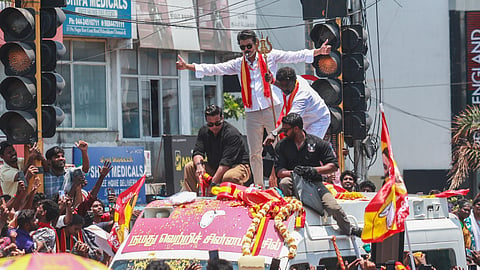
So, in Tamil Nadu, where the ruling party DMK was strongly tipped to win and the AIADMK-BJP alliance to come in second, a totally untested third alternative, the Tamilaga Vettri Kazhagam (TVK), led by actor Joseph Vijay, surprised the whole field bar one stray pollster with a reputation for getting it wrong. In West Bengal, where the BJP was expected to run the Trinamool Congress close, it broke into power with a surprisingly decisive majority, cheered on by the Election Commission and a multitude of other state agencies.
On the predictable side, Kerala oscillated back to the United Democratic Front (UDF) after two terms by the Left Democratic Front (LDF). And in deeply-polarised Assam, the anti-Muslim hate rule of the BJP led by Himanta Biswa Sarma was given a third term in office. In Puducherry, the National Democratic Alliance led by the All India N.R. Congress is set to retain power, as expected.
The most interesting, intriguing and significant of these verdicts is the one in Tamil Nadu. Film star Vijay’s first-time feat is justifiably being compared to MGR’s victory leading the AIADMK in 1977 and N T Rama Rao’s victory leading the TDP in Andhra Pradesh in 1983, both of which foretold huge changes in Indian politics. MGR’s win settled Tamil Nadu into a Dravidian binary in which the DMK and AIADMK had it all to themselves, with the Congress reduced to a makeweight.
Following on from Tamil Nadu, NTR’s victory made Andhra Pradesh the second state in the south where a regional party could successfully and sustainably stave off the Congress. These proved to be the models for the growth of regional parties in several states since then.
The preeminent national party progressively lost ground in each state, leading to a redefinition of India as a federal polity and heralding the era of coalition politics. Now, at a time when the BJP, the Congress’s successor as the imperial national party, is bidding to take India back a full circle, the Centre-state tussle is back in the news again, especially vis-à-vis the South, with Tamil Nadu again in the lead.
TVK’s victory at this juncture puts us in uncharted territory. With an inexperienced and as-yet undefined political party in power, outcomes cannot be predicted with certainty from here. How strong is TVK’s adherence to the Dravidian identity? What attitude will it adopt towards the BJP — as an ally or opponent? With whose support will it form a government? Will it be able to call the shots? Fortunately, the people have provided us with one pointer in this verdict: The people looked for an alternative to the DMK in this election and settled on TVK rather than the AIADMK with its ties to the BJP.
The other dramatic outcome of this round of elections is the BJP’s breakthrough into Bengal. It was long-threatened and came about finally with the assistance of the entire official machinery. It must momentarily be satisfying to the BJP that the eastern periphery has fallen. But then, there must also be some disquiet that the South hasn’t.