
- Chennai
- Tamil Nadu
- India
- World
- EntertainmentEntertainment
- Business
- Sports
- Lifestyle
- Technology
- Videos
- Explainers
- Editor's Picks

CHENNAI: To states like Tamil Nadu, Karnataka, and West Bengal that have been opposed to NEET since its inception, it is a disappointment that the high-powered task force announced by Prime Minister Narendra Modi to reform the National Testing Agency (NTA) has not been asked to examine the need for a national entrance test for medical college admissions.
The six-member committee has been asked to look at only a small sliver of the entire scenario of access to higher education, a scenario in which socioeconomic, regional and linguistic aspirations ought to be accommodated, but are not, under the NTA dispensation.
The government is seeking measures to make NTA tests more secure, transparent, and technology-driven—repairs rather than an overhaul. It has no mind to examine whether tests for admission to multiple premier educational institutions are best administered by one centralised and nominally autonomous agency.
Highly relevant questions, such as whether NTA exams handicap students from rural, underprivileged or non-English backgrounds, are beyond the remit of this committee.
Since its inception in 2017, the NTA has acquired a patchy record on fairness, equity, and integrity, and has been criticised by all stakeholders bar the government, including students, educators, states, courts, opposition parties, even government-appointed committees.
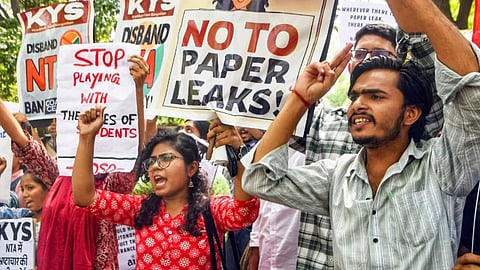
There have been several exam integrity failures such as the NEET paper leaks of 2024 and 2026, recurring technical glitches, poor infrastructure, leaky logistics, and opaque functioning.
These are all problems for which the present committee led by Nandan Nilekani can be expected to suggest capable fixes but what about concerns that NTA exams handicap students from State boards of education, or the criticism of central universities that scores based on multiple choice questions are not appropriate for assessing analytical ability?
Considering the rich and varied experience of the members of this committee, the limited mandate allowed to it is rather piquant. It is apparent that the panel is expected to aid the Union government’s ongoing bid to control all aspects of education, particularly admission to institutes of higher education. Its leader, Nilekani is the architect of India’s centralised digitalisation.
Former ISRO chairman S Somanath and IIT-Madras director V Kamakoti are supporters of traditional Indian knowledge systems; Tapan Deka is a former chief of the Intelligence Bureau—although it’s not clear how his inputs might be relevant to the subject at hand; and Anita Karwal is a former chairperson of the Central Board of Secondary Education. The composition suggests further centralised control, not reform for equity.
This was a lost opportunity to assess the NTA’s performance from a socioeconomic and federal point of view. The findings of the AK Rajan Committee appointed by the Tamil Nadu government in 2021 to examine the impact of NEET would have been useful to consider at this juncture. That committee found that rural students’ share of admissions to government medical colleges fell from 61.5% before NEET to 49.91% after. Conversely, urban students’ share rose from 38.55% to 50.09%.
Tamil-medium students’ share of medical admissions fell from 14.88% in 2016-17 to just 1.6-3.27% post-NEET, and English-medium students' share rose to 98%.
Because such inequities will eventually find their way into medical practice and distance healthcare from the poor, a systemic intervention was called for at this juncture. Unfortunately, the central government is sold on technical fixes rather than equity concerns.