
- Chennai
- Tamil Nadu
- India
- World
- EntertainmentEntertainment
- Business
- Sports
- Lifestyle
- Technology
- Videos
- Explainers
- Editor's Picks
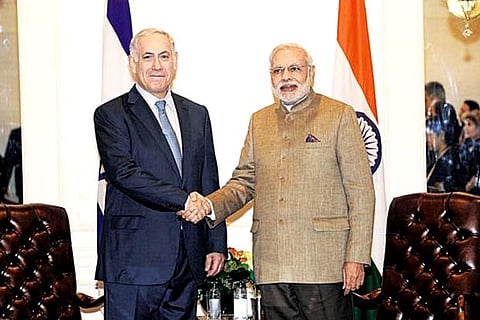
It has been announced in Jerusalem, but not New Delhi, that Prime Minister Narendra Modi will visit Israel on February 25-26.
It was Israeli PM Benjamin Netanyahu who, on February 15, first broke the news of a prospective Modi visit while speaking at a conference of American Jewish Organisations.
Media reports quoting ‘official sources’ have since then been purveying details of the trip, which include an address to the Israeli parliament, the Knesset.
Although a week has passed, neither the Ministry of External Affairs (MEA) nor the Prime Minister’s Office has issued a communique.
The What’s New section of the MEA website lists no upcoming outbound plans by PM Modi.
We now have quite a sequence of such protocol abnormalities. Back in May 2025, the pause in Operation Sindoor was first tweeted by Donald Trump in Washington.
Earlier this month, the so-called framework for an Indo-US trade deal was heralded first by the American President.
The fine print of it was revealed by a ‘joint statement’ posted on the White House website.
It is perplexing why, by being a passive party to such one-sided disclosures, New Delhi is copping the risk of appearing to be not in control of its own actions and decisions.
If it indeed comes to be, the visit to Israel will be Modi’s second, after his historic first in July 2017.
Netanyahu is very excited about cementing a “tremendous alliance” with his friend Modi, but this may not be a propitious time for their tryst.
There are war clouds over Iran at this very moment, with a US armada menacing the Persian Gulf and Red Sea even as talks are being held with Tehran to kill its nuclear weapon plans.
Israel is egging on the US to launch an attack, which media reports say could begin this weekend.
Plans for a Prime Ministerial visit to Israel at this juncture sound incongruous indeed and remind us of the embarrassment to India back in 1979 when China launched an attack on Vietnam, even while our external affairs minister AB Vajpayee was visiting Beijing.
A visit to Israel at this time would not be opportune for other reasons as well. Just this week, there was a brutal assault on Indian workers in Ashkelon in Israel.
Plus, on Wednesday, India at the UN unexpectedly added its name to a list of 100 countries criticising Israel for its actions in the West Bank. For the current government in New Delhi, this is a major departure from its spectator’s position on the ongoing genocide in Gaza.
And then there is the Jeffrey Epstein scandal, in which it is becoming increasingly evident that the now sexual predator had intimate links to international intelligence agencies, including Israel’s, which he used to facilitate connections between shady operators, arms dealers, leaders of government and business.
At least two Indian personalities, Petroleum Minister Hardeep Puri and billionaire Anil Ambani, have been revealed to figure in such confabulations with the now deceased criminal, purporting to arrange important meetings for apex Indian personalities.
Such has been the fallout of the scandal that even Bill Gates has cried off from speaking at the Indian AI summit in New Delhi on Thursday. It would be best to give Israel a wide berth at this moment, regardless of any geopolitical expedients.
