
- Chennai
- Tamil Nadu
- India
- World
- EntertainmentEntertainment
- Business
- Sports
- Lifestyle
- Technology
- Videos
- Explainers
- Editor's Picks
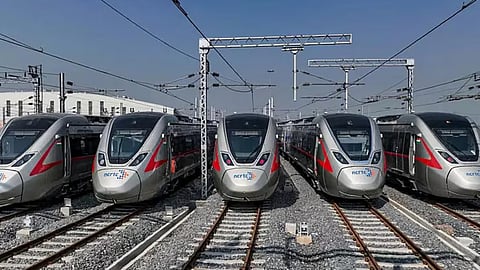
The inauguration of India’s first Regional Rapid Transit System (RRTS) is a major milestone achievement, and the BJP-led NDA government has successfully completed a project that has its origins in a Planning Commission task force set up under the UPA regime in 2005.
The 82-km Delhi–Meerut Namo Bharat Corridor, built at Rs 12,930 crore, has had its share of delays caused by bottlenecks, petty politics, and ensuing litigation. From cabinet approval in 2019 to final commissioning in February this year, the project took about seven years, while the average gestation period should have been nearly half of that.
Despite that, it is a major achievement given the fact that many central government infrastructure projects experience inordinate delays and consequent cost overruns. Another significant aspect is the seamless integration that enables the dual use of the corridor, as Metro services will also operate on the same RRTS infrastructure between Meerut South and Modipuram.
Now that the first system has finally taken off, the Centre should actively promote and expedite other RRTS projects. For instance, the Third Master Plan for the Chennai Metropolitan Area (2027–2046) has a Comprehensive Mobility Plan which includes four RRTS corridors and integrating them with the 12 Metro corridors that will come up.
Typically, these projects are funded by the State and Central governments, with international multilateral agencies generously chipping in. The Chennai–Vellore–Villupuram–Chengalpattu corridor is one of the corridors identified by the Economic Survey 2025-26. The other prominent ones included in the 2,900-km plan are Bengaluru–Mysuru–Tumakuru–Hosur and Hyderabad–Warangal.
Recently, the Kerala government has given in-principle approval for an ambitious 583-km-long RRTS project that will connect the state capital, Thiruvananthapuram, in the south with Kasargod in the north, traversing across the state.
The proposed project, to be executed in four phases, envisages building the corridor on elevated pillars not only to reduce the acquisition of large tracts of land but also to prevent obstruction of the natural flow of water. Since an earlier high-speed rail corridor project named SilverLine could not make progress, the state government is pinning its hopes on the present RRTS project.
The success of Metro networks launched in the UPA era and expanded under the NDA government has paved the way for the RRTS corridors. The governments at the Centre and the states are rightly focusing on Metro-RRTS to address the challenge of mass transit. Besides revolutionising urban travel by significantly reducing travel times, they also reduce road congestion and vehicular pollution.
The governments have rightly adopted a broader approach of viewing it not just as a transport solution but as an integral part of a decentralised economic growth model. At a macro level, it enables decentralisation of urban development by reducing pressure on the core of cities which are bursting at the seams.
The development of polycentric cities, similar to Tokyo and London, is critical for sustainable growth. In the words of the Economic Survey, it could “unlock high economic multipliers and support the emergence of India’s mega regions as engines of growth”.
The success of future RRTS projects would depend on the Centre and states working together amicably in a non-partisan manner and in the larger national interest. Secondly, RRTS is merely a catalyst, and governments and the private sector should create economic opportunities which are critical for overall development and even the viability of mass transit systems themselves.
