
- Chennai
- Tamil Nadu
- India
- World
- EntertainmentEntertainment
- Business
- Sports
- Lifestyle
- Technology
- Videos
- Explainers
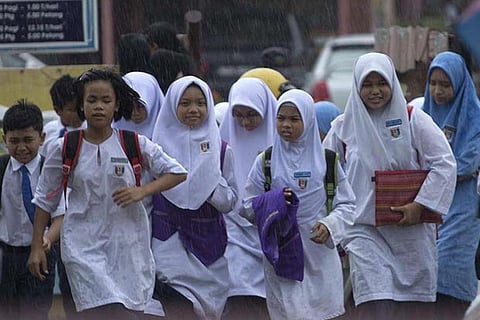
The politics of school uniforms has surfaced again with the Congress government in Karnataka issuing an order this week specifying a limited number of faith symbols that children can wear to school. It lists the hijab (headscarf), turban, janeu (sacred thread), Shivadhara (amulet) and rudraksha as religious accessories that can be worn with the prescribed uniform — as long as doing so does not compromise safety, student identification and classroom discipline.
This decision essentially reverses an order passed by the previous BJP state government in February 2022, strictly mandating that only the prescribed uniform be worn to school. That diktat went down poorly with the Muslim community, as it effectively meant that the hijab could not be worn within campus and that students who refused to remove the headscarf could be denied entry into classrooms and examination halls.
The latest order is a sensible one because it leaves enough room for school managements, parents and students to collectively and respectfully negotiate what symbols of faith are appropriate for a learning environment and what constitutes a needless assertion of identity. Instead of treating schools as a playground for identity politics, it trusts these primary stakeholders to be guided by good sense.
The BJP government’s 2022 order, although couched as a secular measure, triggered bitter opposition by Muslim students and ended up in court, where it remains today. The Karnataka High Court upheld the order and ruled that wearing the hijab is not an essential religious practice in Islam and therefore not deserving of protection under Article 25 of the Constitution. In the Supreme Court, a two-judge bench gave divergent verdicts, with one judge ruling that a uniform dress code promotes equality and was thus appropriate for school, and the other stating that wearing the hijab was a matter of individual choice, which the state had no business to dictate. The issue awaits hearing by a larger bench.
Until we get closure on the matter, which most schools manage without ruffling feathers, we will continue to suffer periodic paroxysms over treating our children as soldiers of faith. The BJP in Karnataka has been quick to portray the state government’s latest order as an appeasement of Muslims, conveniently omitting the fact that it gives no special pass to the hijab and allows other symbols of faith to be worn, but with discretion.
The BJP argues that it’s not only in India that uniform dress codes have been imposed on schools. Most notably in France, there is a total ban on conspicuous religious symbols, including the hijab and the abaya. In Tajikistan, Uzbekistan and Kazakhstan, all countries with majority Muslim populations, secular uniforms without hijabs are strictly enforced in schools. The purpose of such regimes is to make school a neutral space and to make every child look the same, which is not nice at all. The BJP claims to be guided by the equality principle, but we know from its yen for the Saraswati Vandana and the full version of the Vande Mataram that it’s not the whole story.
Instead of grand ideologies, it’s more useful to be guided by simple goals like safety, on which all can agree. And that is a matter best left to the parent, the teacher and the child.
