
- Chennai
- Tamil Nadu
- India
- World
- EntertainmentEntertainment
- Business
- Sports
- Lifestyle
- Technology
- Videos
- Explainers
- Editor's Picks
True to its tone-deaf response to any form of Gandhian protest, the BJP-led Union Government is trying to disrupt the hunger strike by Sonam Wangchuk demanding the resignation of Union Minister for Education Dharmendra Pradhan over the NEET paper leak scandal.
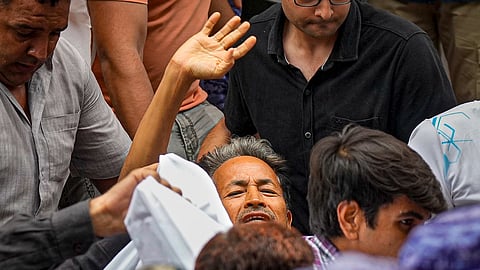
At 7 am on Saturday, July 18, the 21st day of the fast, plainclothesmen of the Delhi Police snuck inside the Jantar Mantar protest site at an unguarded moment and, behind the cover of bedsheets, shifted the fasting activist to Safdarjang Hospital.
This Union Government’s action was predictable. With the Monsoon Session of Parliament beginning on Monday, and the Cockroach Janta Party (CJP)planning a march to Sansad Bhavan, with Wangchuk leading the way in a wheelchair, it is obvious the Narendra Modi government wanted to avoid any adverse optics. Total disregard and then disruption, rather than dialogue, is this regime’s standard operating procedure in the face of an agitation.
We saw this play out with the Indian women wrestlers’ protest at the same site in 2023. Completely impervious to allegations of sexual harassment levelled against top officials by women wrestlers who had won Olympic medals for the country, protesters were dragged away by police ahead of a planned march to Parliament. In 2018, environmentalist GD Agarwal was forcibly taken from his Uttarakhand ashram and admitted to hospital on the 111th day of his indefinite fast seeking a cleanup of the Ganga, an issue that should have been dear to BJP leaders. The 86-year-old former IIT professor died of starvation, and his death elicited only a peremptory note of sadness from the government. It was months later that new norms for pollutants in the river were notified, without as much as an acknowledgement of Agarwal’s sacrifice.
Such intransigence to peaceful protests stands in stark contrast with the response of the erstwhile UPA 2 government to Anna Hazare’s anti-corruption fast in 2011, which too was backed by ‘non-political’ activists of uncertain provenance and supported by Delhi intellectuals claiming to be ‘civil society’. Then, leaders of the India Against Corruption (IAC) were treated with excessive deference and invited into a committee of senior ministers to draft a Jan Lokpal legislation. Unfortunately, some in that movement allowed themselves to be steered by unseen hands, which led the nation into the authoritarian morass we find ourselves in today. It is because of the bitter denouement of that movement that the public today has become wary of Samaritans announcing altruism as their only motivation and using party agnosticism as cover.
The CJP is the product of a quirky algorithm. Little is known about its ideological moorings. Unlike the IAC, whose iconography at least offered clues to the discerning as to its antecedents, CJP’s mascot is an AI-drawn caricature. As things stand, its one-point demand, the resignation of a powerless Education Minister, is easy enough to concede through a government legerdemain. What happens then? To be able to win a wide swathe of support, the CJP needs to define itself as a political entity, not just something given ephemeral life by a viral moment. The public will look hard at unfolding events whether there’s more to the CJP than just a lark.
